

Malaysia is still growing. But the numbers that matter are not just about size. They are about timing. And that timing is shifting.
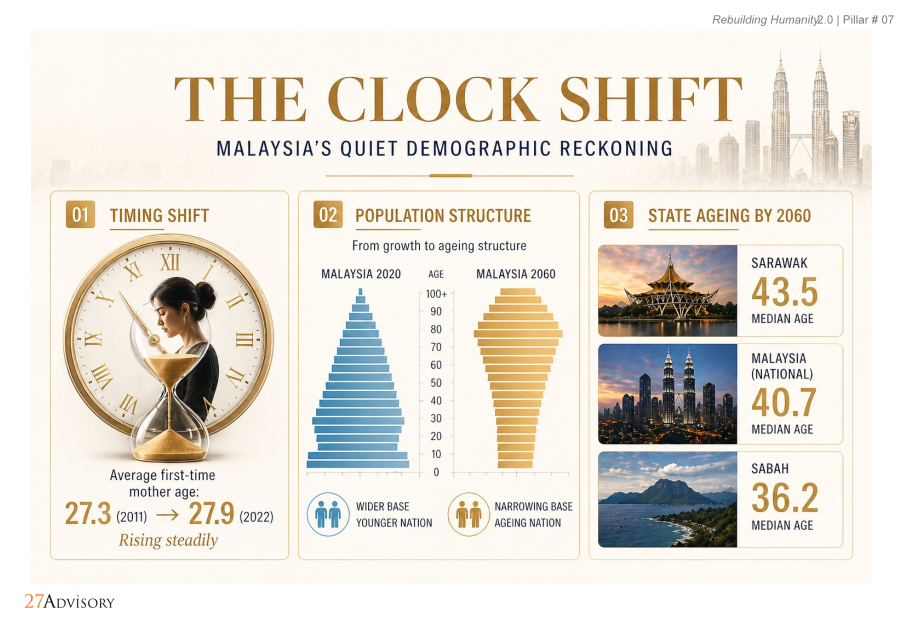
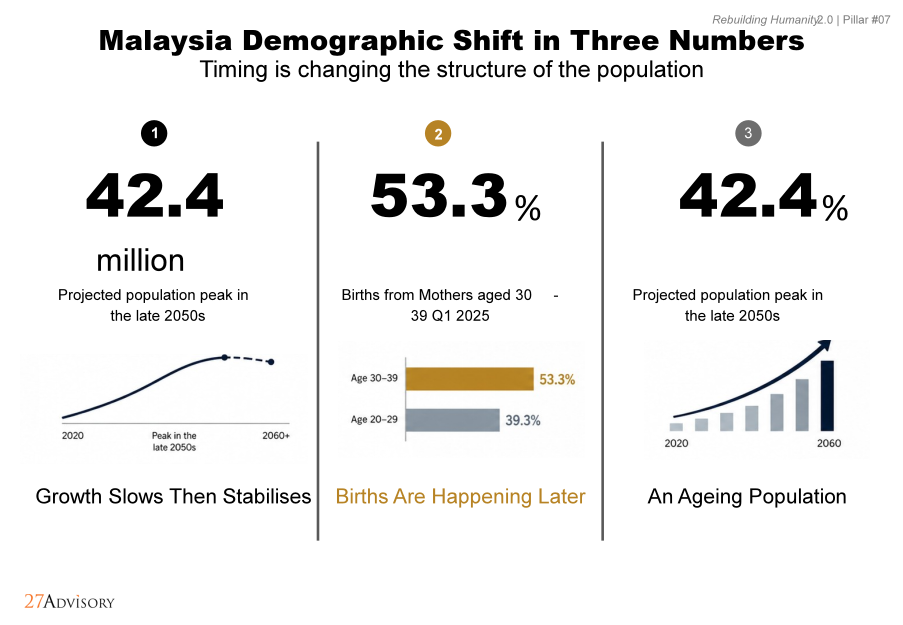
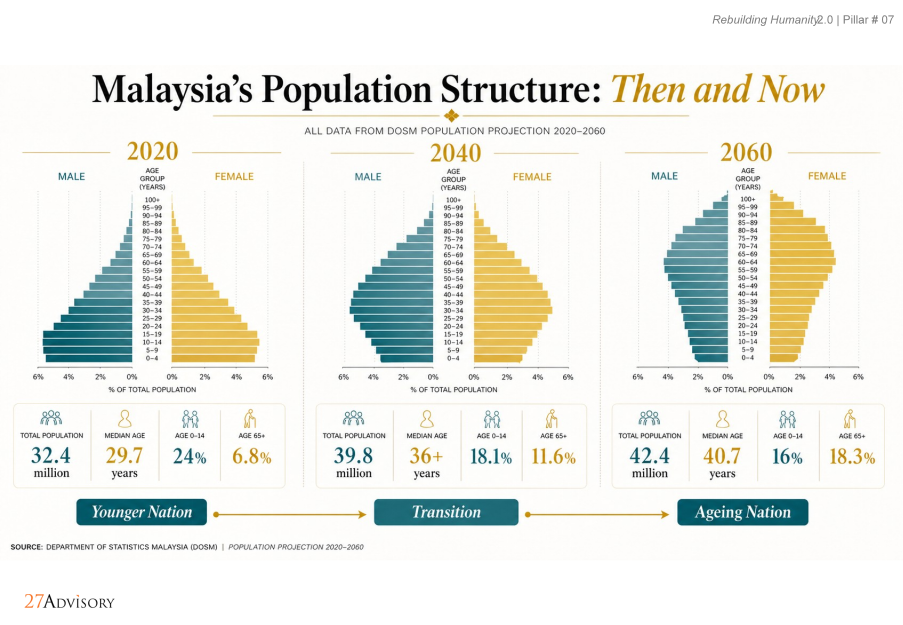
Malaysia is not facing a population collapse. The total population is projected to grow from 32.4 million in 2020 to about 42.4 million before flattening in the late 2050s. The issue is not the number of people. It is the structure of the population.
Babies are still being born. But they are being born later. In Q1 2025, mothers aged 30 to 39 accounted for 53.3% of all live births. Mothers aged 20 to 29 contributed 39.3%. The average age of first-time mothers increased from 27.3 years in 2011 to 27.9 years in 2022. Around 23% of births in 2022 were to mothers aged 35 and above (DOSM). This shows a clear shift towards later motherhood.
Why The Timing Matters
This shift matters. When births happen later, families have less time to have more children. Some will have fewer children than planned. Over time, this reduces the number of young people entering the workforce.
The effects are not immediate, but they are steady. Fewer births today mean fewer workers tomorrow. By the 2040s, a smaller workforce will need to support a larger older population. This is a slow-moving pressure, but it builds over time.
Malaysia is also ageing. The median age was 29.7 years in 2020. It is projected to rise above 40 by 2060. The share of the population aged 65 and above is expected to increase from about 7% today to 18.3% by 2060. Malaysia will begin to feel older within one generation.
The pattern is not the same across states. Sarawak’s median age is projected to reach 43.5 by 2060. Sabah remains younger at 36.2. The national average hides these differences. Some states will age much faster than others.
What the global evidence tells us
Malaysia is not alone in this. Across the world, people are having fewer children, having them later, and living longer. That sounds like good news. But there is a catch. More of those extra years are being spent in poor health. In 2000, the average person lived 8.7 years with illness or chronic disease. By 2025, that had risen to 10.2 years. By 2050, it is projected to reach 11.4 years.
For Malaysia, this matters deeply. More years of poor health will increase pressure on hospitals and strain public finances. At the same time, a shrinking younger workforce could reduce productivity and national income, weakening the country’s broader economic balance. The McKinsey Health Institute also found that in nearly 62 countries, governments already spend more on debt repayment than on healthcare. Prevention, which is the most cost-effective tool available, gets less than 2% of health budgets on average. Malaysia cannot afford to follow that pattern.
Malaysia's response: a blueprint on paper
The government has taken initial steps to develop a policy response to population ageing. In 2025, the government introduced the National Ageing Blueprint 2025–2045, covering six key areas: economy, employment, education, social protection, health, and long-term care. The framework deserves recognition. It shows that population ageing is now part of the national policy agenda. But recognition is not the same as readiness.
The real test lies in implementation. The blueprint will only matter if it leads to support that people can actually access and rely on. Older Malaysians face not only the risk of inadequate income, but also the risk of being missed by fragmented aid schemes, complicated application processes, and limited levels of support. Employers remain slow to retain or hire older workers. Lifelong learning has yet to become a real system. Primary healthcare, which sits at the centre of healthy ageing, remains under-resourced for the burden it is expected to carry.
A good plan only matters when it becomes real in practice. By 2048, when Malaysia is projected to become a fully aged nation, this framework must move beyond paper and begin to change how people live, work, age, and receive care.
Three things worth doing now
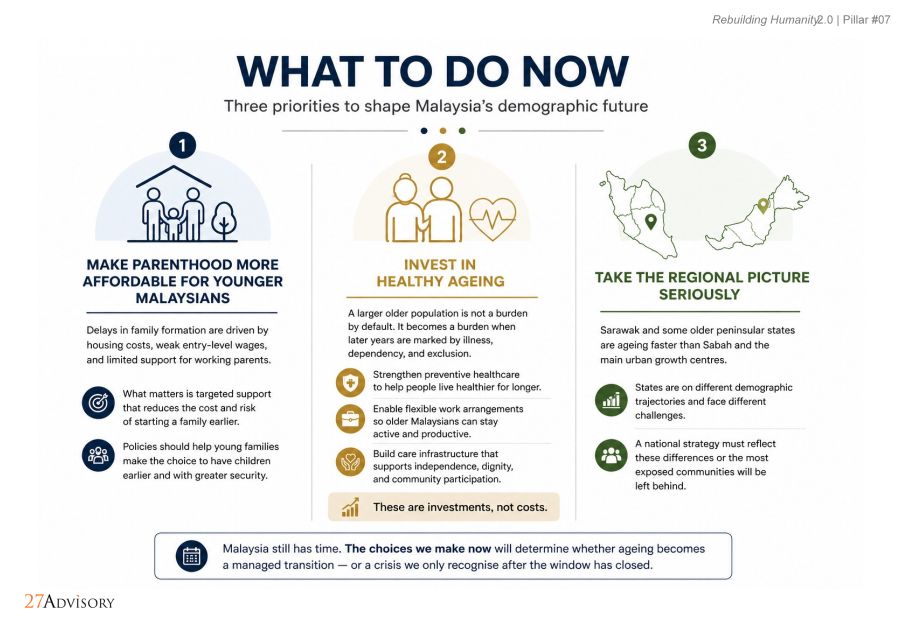
The first step is to make parenthood more affordable for younger Malaysians. The delay in family formation is not random. It is shaped by housing costs, weak entry-level wages, and limited support for working parents. What matters is not a broad pro-birth campaign. What matters is targeted support that reduces the cost and risk of starting a family earlier.
The second step is to invest in healthy ageing. A larger older population is not automatically a burden. It becomes a burden only when later years are marked by illness, dependency, and exclusion from work or community life. Preventive healthcare, flexible work arrangements for older Malaysians, and better care infrastructure should be treated as investments, not costs.
The third step is to take the regional picture seriously. Sarawak and some older peninsular states are ageing faster than Sabah and the main urban growth centres. A national demographic strategy that ignores these differences will leave the most exposed communities behind.
Malaysia still has time. But the window for making these choices will not stay open forever. The clock has been ticking quietly. It is time to listen.
This article is part of 27Advisory’s Rebuilding Humanity 2.0 framework, a nine-pillar knowledge architecture for navigating Malaysia’s most consequential structural transitions. The themes explored in this piece connect directly to Pillar #07: Secondary Healthcare & Care Economy — which examines how Malaysia builds the human, institutional, and financial infrastructure required to serve an ageing population while transforming care into a productive economic sector. To explore 27Advisory’s sectoral research and advisory work, visit our webpage CLICK HERE