



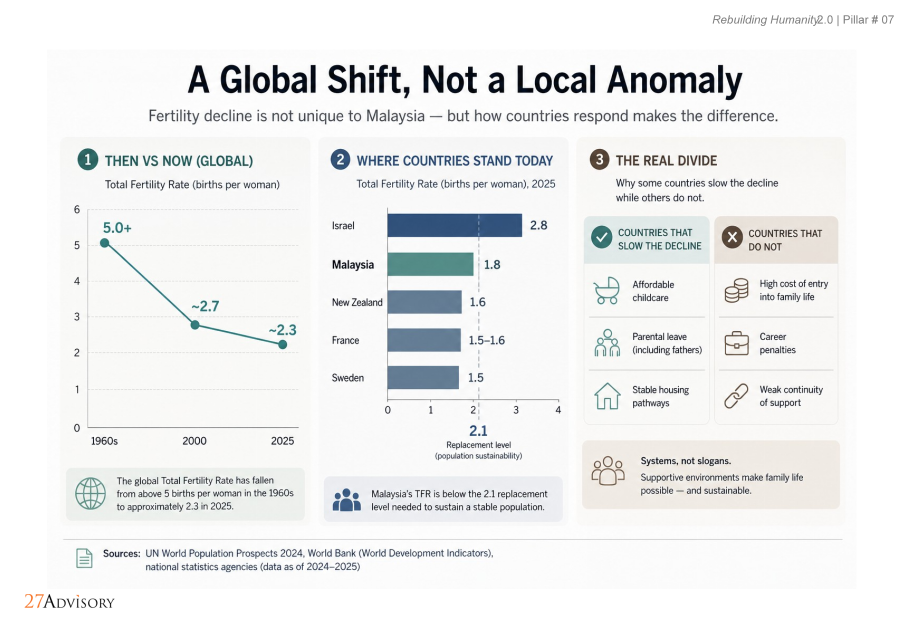
The global Total Fertility Rate has fallen by nearly half since the 1960s, from above 5 births per woman to approximately 2.3 today. In some advanced economies, it has dropped below 1.5. Our grandmothers raised six children on one income. Today, couples with two incomes hesitate before one. That is a decline of more than 50 percent in one generation.
Malaysia’s fertility rate tells the same story. It now sits at approximately 1.8, below the 2.1 replacement level needed to sustain a stable population. The long-term consequences are significant: an ageing workforce, rising care burdens, and slower economic renewal.
But the question worth asking is not why Malaysians want fewer children. The sharper question is whether marriage and family formation have become too costly, too delayed, and too unsupported to sustain.
What Slows the Decline
Countries that have slowed fertility decline share one pattern. They did not tell people to have children. They made family life less costly to choose. France invested in childcare and family benefits. Sweden normalised shared parenting through stronger paternity leave. New Zealand maintained public services that made family life less isolating. Israel remains an outlier, supported by strong community structures and accessible childcare. None is a perfect model, but the evidence is clear: where systems support family formation, decline is slower and less severe.
What Employers Can Do
Workplace design shapes whether people dare to marry, pause careers and return as parents. This matters for men as well as women. Shell’s structured career break programme reduces one common fear around parenthood: that stepping away, even briefly, means falling permanently behind. Google’s extended parental leave improved retention among new mothers, while Unilever and similar firms have moved toward equalised parental leave, normalising father involvement. The pattern is consistent. When employers treat family life as compatible with career progression, people are more willing to build one.
When Family Formation Becomes Too Expensive to Begin
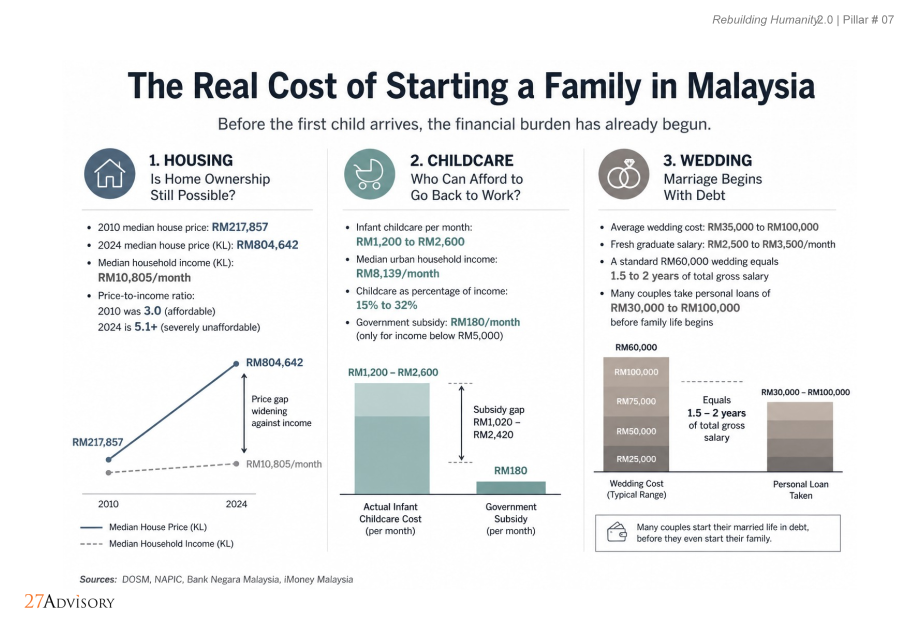
The pressure begins before a child is born. Young Malaysians are often expected to make several major financial decisions at once: marriage, housing, childcare and long-term education planning. In Kuala Lumpur, housing affordability remains a material constraint, with median house prices placing ownership beyond the easy reach of many young households. At the same time, AKPK estimates that raising one child from early childhood to university may cost between RM393,000 and RM1.37 million, depending on education pathway and living costs. Parenthood, in this sense, is no longer only an emotional decision. For many households, it has become a long-term financial commitment made before income, housing and care arrangements are fully secure.
The cost of marriage itself adds another layer. When weddings become large financial commitments before family life has even begun, couples may enter marriage with debt instead of stability. This matters because fertility decisions are not shaped by income alone. They are shaped by whether people feel that family formation is socially and financially survivable. Simpler, affordable marriage should therefore be treated as a dignified and intelligent choice, not a lesser one.
When the entry cost of family life rises, delay becomes rational. Couples wait until income is steadier, housing is secured, debt is reduced and childcare feels manageable. Yet the time needed to reach that stability can quietly narrow the biological window for family formation. Fertility declines with age, particularly from the mid-30s, while later pregnancies often require stronger maternal and prenatal care. This does not mean women should be pressured into earlier motherhood. It means the system should stop making stability so difficult to achieve that biological risk becomes the private cost of economic delay.
There is also a social cost to consider. In urbanising societies, parenthood is increasingly associated not only with love and continuity, but also with career interruption, financial strain, judgment and loss of personal freedom. When these signals accumulate, family formation slows. Malaysia cannot address falling fertility by looking only at affordability. It also needs to examine whether its social environment still makes marriage, parenting and care feel respected, supported and possible.
The changing marriage market adds another layer. As women become more educated and economically independent, expectations of partnership naturally change. The issue is not that women have moved forward. It is whether enough men are being prepared, educationally, economically and emotionally, for stable family life. Fertility decline is therefore also a signal about male readiness, not only female choice.
Making family life possible again
Making family life possible again requires more than isolated incentives. Marriage must be affordable to begin. Housing must be within reach before children arrive. Childcare cannot consume a disproportionate share of household income. Workplaces must allow parents, including fathers, to step back temporarily without permanent career consequences. And society must treat family life as a contribution, not a liability.
No single initiative will produce this. What matters is consistency over time: governments, employers and communities sustaining the same direction across years, not across election cycles.
Malaysia understands the problem. The real test is whether it can sustain the work long enough for family life to feel possible again.
This article is part of 27Advisory’s Rebuilding Humanity 2.0 framework, a nine-pillar knowledge architecture for navigating Malaysia’s most consequential structural transitions. The themes explored in this piece connect directly to Pillar #07: Secondary Healthcare & Care Economy — which examines how Malaysia builds the human, institutional, and financial infrastructure required to serve an ageing population while transforming care into a productive economic sector. To explore 27Advisory’s sectoral research and advisory work, visit our webpage, CLICK HERE