

Safety is almost always the first word invoked when nuclear energy enters Malaysia’s public conversation. In official statements, policy discussions and public debate, nuclear is often framed alongside safety, security, transparency and sustainability.
That is both necessary and expected. Nuclear energy is not merely another source of electricity. It carries questions of trust, sovereignty, emergency preparedness, radioactive waste and the state’s ability to govern a technology whose consequences can outlive a generation.
The harder question, therefore, is not whether safety is being named as a principle. It is whether safety is actually shaping the sequence of Malaysia’s nuclear pathway: the laws, regulator, emergency systems, radioactive waste framework, financing model, technical workforce and public communication that must be in place before any major commitment becomes difficult to reverse.
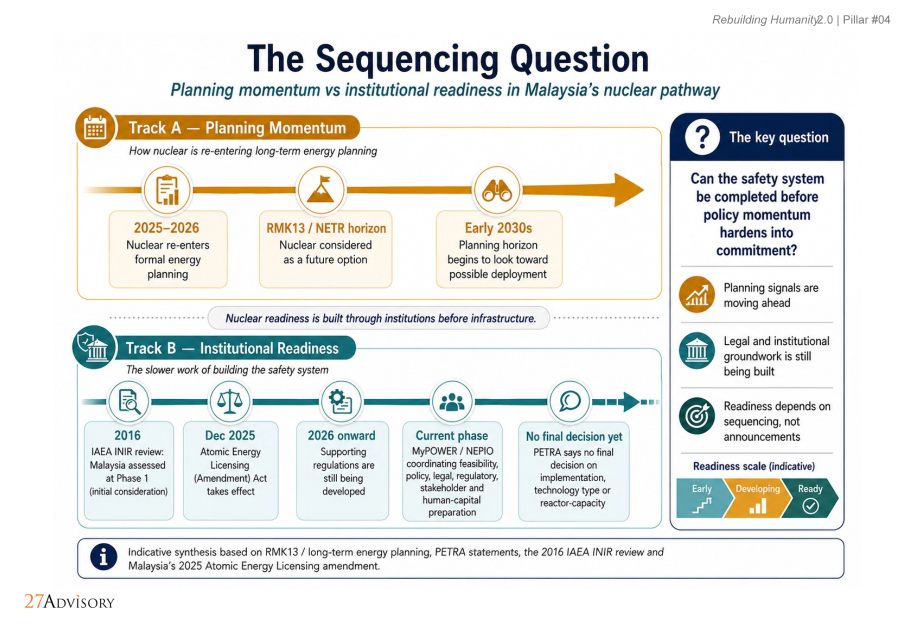
Malaysia’s nuclear energy plan is now under active review. MyPOWER Corporation, an agency under the Ministry of Energy Transition and Water Transformation, has been appointed as the Nuclear Energy Programme Implementing Organisation, or NEPIO, to coordinate the country’s preparatory work based on the phased approach recommended by the International Atomic Energy Agency.
This assessment covers policy development, legal and regulatory frameworks, project feasibility, industry participation, stakeholder engagement and human capital development. PETRA has also stated that no decision has been made on implementation, technology type or reactor capacity. In other words, Malaysia has not crossed into a construction decision. It has entered a structured national assessment of whether the conditions required for a safe and credible nuclear power programme can be developed.
That distinction matters. The question is not whether Malaysia should approve nuclear power today. The question is whether the country is building the safety system early enough, and properly enough, before any major decision becomes irreversible.
Not starting from zero, but not ready yet
Malaysia is not new to nuclear technology. The country has operated the TRIGA PUSPATI research reactor in Bangi since 1982 for training, research, isotope production and other peaceful nuclear applications. That experience gives Malaysia a useful base of technical knowledge.
Beyond the research reactor, Malaysia has also begun organising its wider nuclear technology ecosystem through policy. In 2023, MOSTI launched the National Nuclear Technology Policy 2030, or DTNN 2030, as a long-term policy framework to mainstream the peaceful use of nuclear technology in Malaysia. The policy covers six focus sectors: medicine and healthcare, food and agriculture, device and equipment manufacturing, environmental and natural resource management, industrial applications, and nuclear safety and security.
This matters because it shows that Malaysia already has a wider peaceful nuclear technology ecosystem. Nuclear technology is already used in research, medicine, agriculture, industry and environmental management. DTNN 2030 also places emphasis on legal and regulatory foundations, communication, education and public awareness, and future readiness as part of that ecosystem.
But electricity generation is a different threshold. Moving from peaceful nuclear applications to commercial nuclear power would require a larger national safety architecture: not only scientific expertise, but also a mature regulator, radioactive waste planning, emergency preparedness, safeguards, financing, grid readiness, industrial capacity and public trust.
In other words, experience is not the same as readiness. It is a foundation, not a guarantee.
What the international benchmark measures

The benchmark for Malaysia’s preparatory work is the IAEA’s Milestones Approach. This framework assesses a country’s readiness across 19 infrastructure areas, including national policy, legal and regulatory framework, nuclear safety, nuclear security, safeguards, radioactive waste management, human resources, financing, emergency planning and stakeholder involvement.
This is an important point for Malaysia’s public conversation. Nuclear safety is not only about reactor design. It is a national system. It depends on the strength of the law, the independence of the regulator, the competence of the operators, the credibility of emergency planning, the management of radioactive waste and the honesty of public communication.
Malaysia’s earlier IAEA review in 2016 assessed the country against Phase 1 of this process, the stage of initial consideration. Being in the early phase is not a failure. It simply means that the country is still building the ecosystem required before it can move into more advanced stages of commitment.
The rulebook is still being completed
There has been real movement. The Atomic Energy Licensing (Amendment) Act 2025 was gazetted on 28 November 2025 and came into operation on 1 December 2025, strengthening the legal framework for atomic energy activities and expanding oversight to safety, security and safeguards.
However, the amendment is being implemented in stages. Several provisions, including those related to permits, financial guarantees and the Radioactive Waste Fund, will only come into force once supporting regulations are drafted.
This does not mean Malaysia is unprepared. It means preparation is still underway. A law can signal direction, but the full safety system depends on the regulations, institutions and enforcement capacity built beneath it.
For nuclear energy, this sequencing is critical. A country should not wait until a reactor project is near approval before completing the rulebook that will govern it.
Other countries offer a useful lesson here. The Philippines, for example, has moved to establish PhilATOM as an independent nuclear regulator as part of its renewed nuclear pathway. Outside Southeast Asia, countries such as the United Arab Emirates and South Africa show that nuclear development is rarely built on technology procurement alone. It depends on long-term partnerships, financing structures, regulatory credibility, training and public confidence.
The lesson for Malaysia is not to copy another country’s model wholesale. It is to recognise that nuclear capability is built through institutions before infrastructure.
Why public trust is part of safety
Malaysia already understands how sensitive the management of radioactive materials can be. Public unease around rare earth processing and radioactive residue is not the same as a nuclear power plant debate, but it has shaped public expectations about transparency, regulation and long-term waste responsibility.
That history matters because nuclear energy is a high-trust technology. Technical compliance alone will not be enough if the public does not understand how safety decisions are made, who is accountable, where radioactive waste will go, and how risks will be monitored over time.
In this sense, public communication is not a public relations exercise. It is part of the safety architecture. A nuclear programme that cannot explain itself clearly will struggle to earn legitimacy, even if it meets technical requirements on paper.
When safety shapes the sequence
Malaysia has valid reasons to study nuclear energy seriously. Rising electricity demand, the growth of data centres, decarbonisation goals and the need for a more resilient power system are all increasing pressure on long-term energy planning. Nuclear has entered that conversation because it offers the possibility of firm, low-carbon power.
But urgency must not decide the sequence.
Malaysia should neither stall nuclear preparation because of fear nor accelerate it simply because demand is rising. The real test is whether the country can complete the safety system before any nuclear decision becomes irreversible.
That means building the law, the regulator, the waste framework, the emergency systems, the technical workforce, the financing model and the public conversation before the country moves from studying nuclear to committing to it.
Malaysia is not yet being asked to choose nuclear power. It is being asked to prove that it is willing to do the slow, unglamorous work that must come first.
That work may not make headlines. But it is the only thing that can make any future decision credible enough for Malaysians to trust.
This article is part of 27Advisory’s Rebuilding Humanity 2.0 framework, a nine-pillar knowledge architecture for navigating Malaysia’s most consequential structural transitions. The issues explored in this piece connect directly to Pillar #04: Energy, Biomass & Transport Decarbonisation. To explore 27Advisory’s sectoral research and advisory work, visit our Rebuilding Humanity 2.0 page.