

No deductions on your pay slip. No e-Filing season. No hunting for receipts to claim lifestyle relief. For many people, it sounds like freedom.
Here is the surprise. For most working Malaysians, that Malaysia already exists. In July 2026, the Economy Minister said only about 15% of Malaysia’s workforce pays income tax, and linked this to modest wages. Most of the other 85% earn too little, after reliefs, to owe it.
They still pay tax. They pay it when they buy things.
So when people suggest cutting income tax and bringing back the Goods and Services Tax (GST), the idea sounds simple. Tax spending a little more. Tax earnings a little less. On paper, it can work well. But Malaysia has tried a version of this before, and it did not last.
This two-part series asks one question.

In Part 1, we set out the scenario, look at where Malaysia’s money comes from today, follow three households, and check whether the numbers add up. Part 2 looks at what other countries learned, what it would take to make a swap work into practice, and what readers would need to know to judge it.
The idea we test
To answer that question, we test one specific “what if”. It comes from a working scenario prepared for discussion. It is not a government or party proposal, and not an established policy recommendation. We set it out exactly, so readers know what is being examined.
The scenario has four parts:
- The first RM100,000 of chargeable income is tax-free, for every taxpayer. Chargeable income is income after reliefs.
- Lower tax rates above that: 18% on RM100,001 to RM400,000, 19% on RM400,001 to RM600,000, 20% on RM600,001 to RM2 million, and 22% above RM2 million.
- GST comes back in place of today’s Sales and Service Tax (SST).
- Cash help for lower-income households.
Economists call the first part a universal band: every taxpayer gets the same tax-free slice. Malaysia already has a small one. The first RM5,000 of chargeable income is taxed at 0% for everyone. The scenario makes that slice twenty times bigger.
We compare the scenario with Malaysia’s income tax rules for year of assessment (YA) 2027, as announced in Budget 2027. These rules still need to be passed into law.
All the calculations in this article are our own. We apply the scenario’s tax bands to example households, using Malaysia’s actual tax reliefs, and we show every step so readers can check them. We do not estimate the scenario’s effect on economic growth. Lower income tax could encourage spending and work, but GST would also take money out of households’ pockets, and we found no published Malaysian model that weighs the two. So the growth effect remains uncertain.
Why the idea is attractive
The idea has a real case behind it. To see it, it helps to understand how GST and SST differ.
GST taxes a little at every step, but each business only pays on the value it adds. Picture a cake on its way to you. A flour mill sells flour to a baker. The baker sells the cake to a shop. The shop sells it to you. At each step, GST is charged. But each business claims back the GST it paid on what it bought. So the baker only pays tax on the value she added to the flour, and the shop only on the value it added to the cake. In the end, the full tax lands once, on the final price you pay.
SST taxes at one point, and businesses usually cannot claim it back. Sales tax is charged mainly when goods are made or imported. Service tax is charged on a list of services. It is simpler, and fewer businesses have to deal with it. But when a business pays SST on something it uses, such as packaging or a service, that tax often becomes part of its costs. The business then adds its profit on top. The tax gets hidden inside the price, and sometimes there is tax on tax. Economists call this cascading.
That is why many economists prefer GST. It covers almost everything people buy, so a low rate can raise a lot. It does not push businesses to buy one way or another. It is harder to cheat, because each business wants a proper invoice from its supplier to claim back its tax. Exports carry no GST, which helps Malaysian goods compete overseas. And people keep shopping even when oil prices fall, so the revenue is steady.
Australia shows the difference this can make. Its old wholesale sales tax was charged at rates of up to 45% on a narrow range of goods, and more than half of it fell on business inputs. That raised costs for exporters. The OECD makes a similar point about Malaysia today. It says the expanded SST “is not the most efficient way to collect taxes on goods and services”.
The income tax side has its own case. Lower income tax leaves people with more of what they earn. Supporters expect that to encourage people to work more, to invest, and to keep their income in the formal, taxed economy rather than hiding it. Those are the intended benefits. How large they would be in Malaysia has not been measured, so they are possibilities, not promises. For a middle-income professional, a large tax-free slice would mean noticeably more money every month.
What Malaysia needs to solve
A tax reform must solve the right problem. Malaysia’s main problem is not that income tax is too heavy. It is that the country collects too little, from too narrow a base, and leans on a source that is shrinking.
Tax revenue is only about 12.6% to 12.8% of GDP. Oil and gas once filled much of the gap. Petroleum-related revenue made up 41.3% of federal revenue in 2009. The Ministry of Finance’s latest figures put it at 15.1% in 2026 (revised estimate) and 16.1% in 2027. The ringgit amount rises and falls with oil prices: RM75.9 billion in 2023, RM62.7 billion in 2024, and an estimated RM61.2 billion in 2027. So oil revenue does not fall every year. But its share of the budget has more than halved since 2009, and it is a less reliable cushion than before.
At the same time, the government is reducing its deficit. The deficit was 3.7% of GDP in 2025, and Budget 2027 targets 3.3%, on the way to a medium-term ceiling of 3% under the Public Finance and Fiscal Responsibility Act . Federal government debt was 65.2% of GDP at the end of 2025, above the Act’s medium-term target of 60%. A narrower measure, statutory debt, was 63.9% of GDP, just under its separate legal limit of 65%. So any tax change must pass a first test: does it keep public finances on track once every cost is counted? Only then comes the second test: who gains, and who pays?
Budget 2027 proposes several changes to personal income tax. It raises individual relief from RM9,000 to RM12,000, the first increase since 2010. It cuts the rate on chargeable income between RM70,001 and RM100,000 from 19% to 18%, and adds a 24% band for RM100,001 to RM150,000. And it asks more of the very top: the 30% rate now starts at RM1 million instead of RM2 million [3][4][14]. It also raises STR and SARA cash aid to RM16 billion.
The higher relief makes the tax base slightly narrower. The lower 30% threshold asks more from the highest earners. Our “what if” goes much further on the first, and the opposite way on the second.
Where the money comes from today
Budget 2027 expects federal revenue of RM380.8 billion [10]. One detail matters: this Ministry of Finance table is a baseline that leaves out Budget 2027’s own measures [10]. That includes the income tax changes used in our household examples below. So the RM51.8 billion for individual income tax is the figure before those changes. Imagine every RM100 of it:
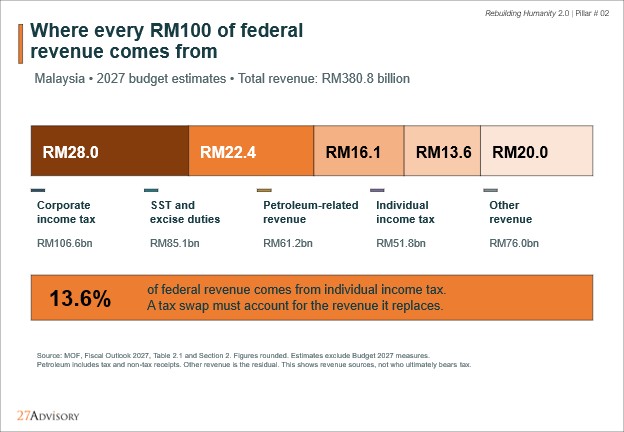
Infographic 1: Where every RM100 of federal revenue comes from
Two things to keep in mind when reading this table.
First, it shows who hands the money to the government, not who finally carries the cost. A company pays its income tax, but part of that cost reaches its owners, its workers and its customers. SST is paid by businesses, but much of it ends up in the prices we pay at the shop. Second, it does not include borrowing. Borrowing is not income. It is a way to fill a gap. The government plans to spend RM459.8 billion in 2027: RM376.8 billion to run the country and RM83.0 billion to build things. The difference from revenue is borrowed. Future taxpayers will help pay that back. But they will also use some of what it builds, such as roads, schools and hospitals. So whether borrowing is fair depends on what it pays for. What the table does show clearly is how small income tax is. It brings in about RM14 of every RM100. For a country with a narrow tax base, giving up a big part of it is a big decision.
Three households, three different stories
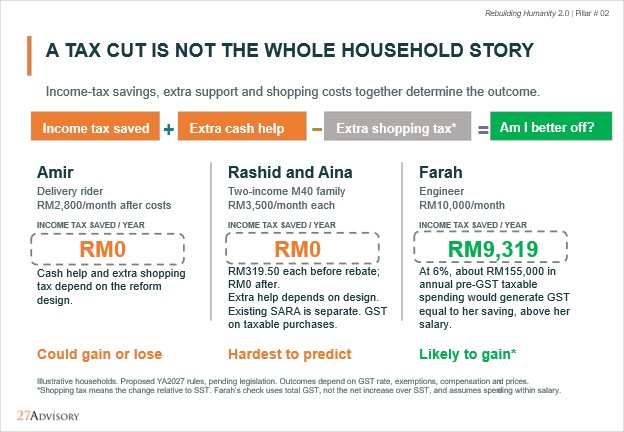
Infographic 2: A Tax Cut Is Not The Whole Household Story
To see what the scenario could mean for households, consider three illustrative examples. They are built from stated assumptions, not taken from real people, and they do not represent all Malaysian households. Their tax figures apply the proposed YA2027 rules and the scenario’s bands, so anyone can check them [4][2].
For each household, the question is not “does my income tax fall?” It is this:
Am I better off? = income tax I save + extra cash help I receive − extra tax I pay when I shop
Amir, the rider
Amir rides for a delivery platform. He takes in about RM4,000 a month in fares. After fuel, maintenance and phone costs, he keeps about RM2,800 a month, or RM33,600 a year. That is close to the typical Malaysian wage: the median monthly salary for citizen employees was RM2,940 in 2025 [17]. He is single, with no dependants, and claims RM12,000 individual relief. His chargeable income is RM21,600. The tax on that is about RM198, and the RM400 rebate for lower incomes wipes it out. He would pay no income tax under the proposed YA2027 rules, and none under the scenario.
So Amir saves nothing on income tax. Does that mean he loses? Not necessarily. Two other things decide it. First, would he get extra cash help, and would it arrive on time? Second, how much more would he pay when he shops? SST would end, but that does not guarantee prices will fall by the same amount. How much of the change that reaches shoppers depends on businesses and competition. If basic food is zero-rated and his help is adequate and on time, Amir could come out ahead. If he falls outside the help, he could fall behind. The design decides.
Rashid and Aina, a two-income family
Rashid and Aina each earn RM3,500 a month. Together that is RM7,000 a month, within the middle-income M40 group. Each claims individual relief (RM12,000), EPF relief (RM4,000) and SOCSO relief (RM350). That leaves each with chargeable income of RM25,650. The tax on that is RM319.50 each before the rebate (1% on RM15,000 plus 3% on RM5,650). The RM400 rebate brings it to zero. Neither would pay income tax under the proposed YA2027 rules.
For this family, the income tax side of the swap brings no saving. Whether they will receive extra cash help depends on how the reform’s compensation is designed. Existing aid is a separate matter. Under Budget 2027 as announced, adults aged 18 and above who do not receive STR are due two RM100 SARA credits. That is current assistance, not compensation for a GST. The family would pay GST on the taxable goods and services they buy, while some basic items might be zero-rated, depending on the design. Their net result depends on those details. For households like theirs, in the lower middle-income range, the outcome is among the hardest to predict.
Farah, the engineer
Farah earns RM10,000 a month, or RM120,000 a year. She is single and claims the individual relief (RM12,000), EPF relief (RM4,000) and SOCSO relief (RM350). Her chargeable income is RM103,650. Income tax works like stairs. Each part of her income is taxed only at the rate of its own step:
Table 1: Farah’s tax, step by step (YA2027)
| Step of chargeable income | Rate (proposed YA2027) | Income on this step | Tax under proposed YA2027 rules | Tax under the scenario |
| First RM5,000 | 0% | RM5,000 | RM0 | RM0 |
| RM5,001 to RM20,000 | 1% | RM15,000 | RM150 | RM0 |
| RM20,001 to RM35,000 | 3% | RM15,000 | RM450 | RM0 |
| RM35,001 to RM50,000 | 6% | RM15,000 | RM900 | RM0 |
| RM50,001 to RM70,000 | 11% | RM20,000 | RM2,200 | RM0 |
| RM70,001 to RM100,000 | 18% | RM30,000 | RM5,400 | RM0 |
| RM100,001 to RM103,650 | 24% (18% under the scenario) | RM3,650 | RM876 | RM657 |
| Total | RM103,650 | RM9,976 | RM657 |
So, Farah saves about RM9,300 a year, or roughly RM780 a month.
Farah would also pay GST when she shops. Could that cancel out her income-tax saving? Suppose every purchase she makes is subject to 6% GST. She would need to spend about RM155,000 a year before GST for the GST bill to match her annual income-tax saving of RM9,319. That is more than her gross annual salary of RM120,000. This illustrates the scale of her saving under the hypothetical proposal. Her actual outcome would depend on her spending and how prices change when GST replaces SST; the full GST bill would not necessarily be an additional cost.
And the highest earners?
In ringgit terms, the largest savings go to the highest incomes. Take someone with RM1 million of chargeable income. Under the proposed YA2027 rules, they would pay RM247,600. Under the scenario, they would pay RM172,000 (18% on RM300,000, plus 19% on RM200,000, plus 20% on RM400,000). That is a saving of RM75,600 a year.
Of that saving, RM9,100 comes from the tax-free first RM100,000, the same slice every taxpayer receives. The other RM66,500 comes from lower rates on income above RM100,000: 18% instead of 24% and 25%, 19% instead of 26%, and 20% instead of 28%. Only people with income at those levels receive that part.
Side by side: Amir and the M40 family save nothing on income tax. Farah saves about RM9,300. The top earner saves about RM75,600. As a share of chargeable income, the savings of the taxpayers are broadly similar: about 9% for Farah and about 7.6% at RM1 million. Larger ringgit savings for higher earners follow directly from the design. On its own, that finding does not settle whether the whole package is good or bad. That also depends on how much revenue GST raises, how it is used, what extra help is given, and how prices change.
Does the money add up?
Every tax swap needs a clear goal. It can aim to raise more money, to raise the same amount, or to boost the economy and accept a bigger deficit. With a medium-term deficit ceiling of 3% of GDP, and debt above the 60% medium-term target, only the first two fit Malaysia’s current commitments.
To know if the scenario meets either goal, five things must be counted:
- How much GST would collect, after refunds. That depends on the rate, on what is left out, and on how well it is collected. Under GST, businesses claim back the tax on what they buy, so the useful figure is what the government keeps after those refunds. As a guide, Customs reported collecting about RM44 billion from GST at 6% in 2017, and GST made up about 20% of federal revenue that year. The economy is bigger now, so GST would collect more today. But we cannot give a figure without a set rate and a list of what is taxed.
- The SST it replaces. GST is not new money from the first ringgit. It must first replace SST, which is expected to bring in RM73.3 billion in 2027. Only what GST collects above that can pay for anything else. Removing SST also does not guarantee that shop prices fall by the same amount. That depends on businesses and on competition.
- The income tax given up. Individual income tax is expected to bring in RM51.8 billion in 2027, before Budget 2027’s own tax changes. Under the scenario, every taxpayer with chargeable income above RM100,000 saves RM9,100 on that first slice, everyone below it pays nothing, and the rates above it fall too. To know the exact cost, we would need LHDN figures on how many taxpayers sit at each income level. Those are not published in a form that allows this calculation.
- The timing of refunds. Refunds are already counted in the first item, so they are not subtracted again here. But their timing matters. If refunds are slow, businesses carry the cost in the meantime. In 2018, a year affected by a backlog and GST’s end in June, net GST collections were RM20.2 billion after about RM23 billion in refunds.
- Extra cash help and set-up costs. Any compensation on top of existing aid, new systems at Customs, and extra paperwork for businesses all reduce the net gain.
Put together, the scenario asks a lot of GST. To break even, GST would have to bring in more than SST’s RM73.3 billion, plus enough to cover most of the income tax given up, plus the cost of any extra help. For the same level of relief to lower- and middle-income taxpayers, extending that relief to higher earners too would mean a larger loss of government revenue. It is also the simplest to understand.
Any additional growth generated by the reform could help offset the revenue loss, but how much it would recover remains uncertain. But we found no Malaysian estimate showing that a tax cut of this size would fully pay for itself through higher growth.
Before Part 2
So far, the picture is this. Amir, and Rashid and Aina, would save nothing on income tax. Farah would save about RM9,300 a year. The highest earners would save the most in ringgit. To pay for it, GST would first have to replace SST’s RM73.3 billion [10], then cover the income tax given up and any extra help.
Whether that is a good bargain depends on things this part has not yet covered: how other countries handled similar swaps, whether help and refunds would actually work, and whether the public would accept the change. That is where Part 2 picks up.
This article is part of 27Advisory’s Rebuilding Humanity 2.0 framework, a nine-pillar knowledge architecture for navigating Malaysia’s most consequential structural transitions. The themes explored in this piece connect directly to Pillar #02: Radical Fiscal and Governance Reset. To explore 27Advisory’s sectoral research and advisory work, visit our Rebuilding Humanity 2.0 page.