


Budget 2026 brings that tension into view. Federal revenue is estimated at RM343.1 billion before this year’s tax measures, while the Federal Expenditure Estimates provide for RM421.2 billion in total expenditure. Operating expenditure alone stands at RM338.2 billion, driven by emoluments of RM109.36 billion, debt service charges of RM58.30 billion, and pensions and gratuities of RM42.15 billion. Development expenditure is allocated RM83.0 billion in the expenditure estimates, including contingency provision. Federal grants and financial assistance to state governments will rise to RM10.26 billion in 2026, up 4.4% from RM9.83 billion in 2025.
These numbers point to a system with narrowing fiscal room. Malaysia’s fiscal question is not only about the size of the budget. It is about whether that budget still connects economic contribution, development need, fiscal capacity and measurable outcomes clearly enough for the public to trust it.
The federal budget has less room to move

Revenue collection in Malaysia remains largely centralised at the federal level. This centralisation is part of Malaysia’s fiscal architecture, allowing the federal government to manage national obligations, redistribution and macro-fiscal stability. The question is not whether centralisation exists, but whether the logic of allocation is visible and disciplined enough.
Expenditure, meanwhile, has become progressively harder to compress. In Budget 2026, emoluments, debt service charges, and pensions and gratuities together amount to about RM209.8 billion, more than 60% of operating expenditure. These are not ordinary line items that can be adjusted easily within a single budget cycle. They are commitments shaped by the size of the public service, past borrowing, and pension obligations accumulated over time.
Development expenditure, by contrast, stands at RM83.0 billion, even though it is the portion expected to carry Malaysia’s longer-term transformation goals. The issue is not that salaries, pensions or debt commitments are illegitimate. The issue is that when the fixed portion of the budget grows, the country’s room to invest becomes narrower. This makes it more urgent that every development ringgit is allocated to the right place, for the right need, with results that can be measured.
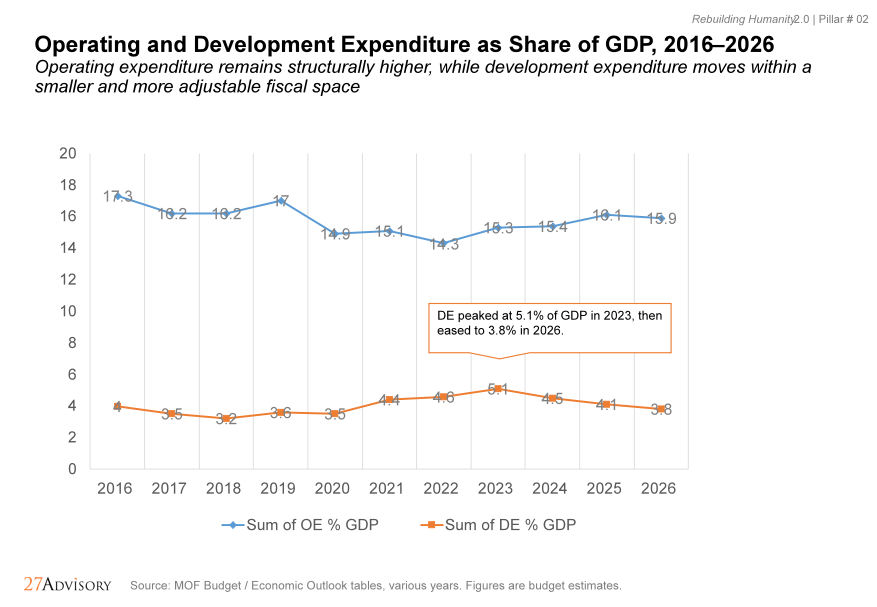
Historical budget estimates show that this is not only a Budget 2026 issue. Between 2016 and 2026, operating expenditure generally remained at about 15% to 17% of GDP. Development expenditure, by contrast, moved within a smaller and more adjustable space. It rose from 3.2% to 4.0% of GDP in the late 2010s to 5.1% in 2023, before easing to 4.5% in 2024, 4.1% in 2025 and 3.8% in 2026. This does not suggest that development spending has collapsed. Rather, it shows its vulnerability: when fiscal room tightens, development expenditure adjusts more visibly, while operating expenditure remains structurally harder to move.
Federal grants and financial assistance to state governments, at RM10.26 billion, are not the main driver of Malaysia’s fiscal pressure. The larger structural issue lies in fixed federal obligations. But the state allocation question still matters because it goes to a different problem: whether public money is distributed through a logic that federal and state actors can see, understand and test against outcomes.
States generate value, but fiscal visibility remains uneven
Selangor, Kuala Lumpur, Sabah and Sarawak illustrate Malaysia’s uneven economic geography in different ways. Selangor and Kuala Lumpur sit at the heart of national output, while Sabah and Sarawak carry distinct development needs, resource questions and obligations tied to the Malaysia Agreement 1963. Yet any direct calculation of what each state contributes against what it receives back must be treated with caution. Such a comparison would require state-by-state federal revenue and expenditure data that is not publicly available in a form that supports fair assessment. Kuala Lumpur also needs separate handling because it is a Federal Territory, not a state government.
The more defensible point is this: it remains difficult to trace how a state’s economic contribution, its own revenue capacity, the federal transfers it receives and the development allocation it is granted connect to one another. That opacity, more than any single funding figure, is what weakens trust in the system.
Rebalancing cannot mean allocation alone
There are real grounds for reviewing allocations to certain states, particularly where infrastructure gaps, service-delivery costs and MA63-related obligations remain significant. But allocation reform cannot stop at the transfer of funds. Without outcome discipline attached, decentralisation risks simply moving inefficiency closer to the ground, rather than resolving it.
A reset also cannot be one-directional. States that seek a stronger fiscal bargain must also carry greater fiscal co-responsibility. Within the limits of Malaysia’s constitutional framework, this means strengthening their own revenue administration, improving land and local-government related collections, co-investing where possible, and showing measurable improvement in delivery outcomes. A clearer allocation framework should therefore recognise need, but also reward effort and performance.
From fiscal discipline to allocation discipline
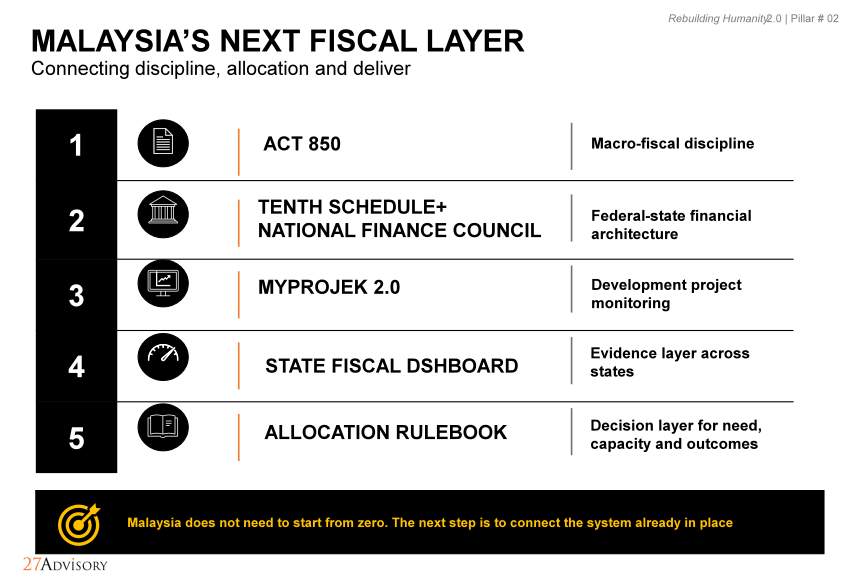
Malaysia already has a macro-fiscal discipline framework through the Public Finance and Fiscal Responsibility Act 2023, or Act 850. The next question is how that discipline can be translated into allocation and delivery: how federal resources are distributed across states, what needs they respond to, what fiscal effort states bring in return, and what outcomes the spending produces.
Malaysia also does not need to rediscover delivery discipline from scratch. Existing mechanisms already monitor project implementation, including MyProjek, which the government is further developing through MyProjek 2.0 to strengthen monitoring of federal development projects. The next task is not to duplicate these systems, but to connect project-monitoring data with fiscal allocation decisions: where development spending goes, what needs it responds to, and what outcomes it produces. The useful lesson from PEMANDU and the Government Transformation Programme is therefore not institutional nostalgia, but the importance of clear ownership, measurable targets, escalation and public-value reporting.
A practical starting point would be a state fiscal and delivery dashboard, supported by a clear allocation rulebook. The dashboard would bring together comparable data on state GDP, own-source revenue, federal grants, development allocations, major federal projects and selected outcome indicators, updated on a consistent cycle. The rulebook would explain how these data inform future allocation decisions, including development need, fiscal capacity, delivery responsibility, state co-responsibility and measurable outcomes.
This should begin as an inter-governmental tool linked to existing constitutional channels such as the National Finance Council, rather than as a crude public scorecard of “who paid and who received.” Over time, selected reporting could help build public trust without turning allocation into political theatre.
Benchmarking the reform
Singapore offers a useful, narrow benchmark for fiscal discipline and cost-effective public expenditure. It is not, however, a workable model for federal-state allocation, since it is a city-state with a very different institutional design.
Australia offers a closer reference for the federal-state allocation question because it has a formal institution, the Commonwealth Grants Commission, that advises how revenue from the Goods and Services Tax should be distributed among states and territories. Its guiding principle is horizontal fiscal equalisation: states with weaker revenue capacity or higher service-delivery costs should still have the capacity to provide broadly comparable public services.
The Tenth Schedule in brief
The Tenth Schedule of the Federal Constitution forms part of Malaysia’s federal-state financial architecture. It sets out key grants, assigned revenues and special provisions for states, including Sabah and Sarawak.
But it is not a full allocation rulebook for modern fiscal decision-making. It does not, by itself, show how economic contribution, fiscal capacity, development need, delivery cost and outcomes should be weighed together.
A modern fiscal reset should therefore work through Malaysia’s existing constitutional framework, not around it, by making allocation decisions more transparent, evidence-based and outcome-linked.
Malaysia does not need to copy Australia’s formula, nor its GST mechanism. The relevance is the discipline behind it: an evidence-based process that makes fiscal capacity, service-delivery needs and allocation logic more explicit. Any Malaysian reform must work through Malaysia’s own constitutional architecture, including the Tenth Schedule, the National Finance Council and existing grant mechanisms.
A new fiscal bargain
Malaysia does not need a budget argument that pits federal against state, or public servant against taxpayer. It needs a new fiscal bargain: clearer allocation logic, stronger state capacity and measurable returns from every ringgit spent.
The next step is to make that bargain measurable.
This article is part of 27Advisory’s Rebuilding Humanity 2.0 framework, a nine-pillar knowledge architecture for navigating Malaysia’s most consequential structural transitions. The issues explored in this piece connect directly to Pillar #02: Radical Fiscal & Governance Reset. To explore 27Advisory’s sectoral research and advisory work, visit our Rebuilding Humanity 2.0 page.