

GDP is usually read as a scorecard. A single number, up or down, good quarter or bad. But a scorecard only tells you whether you won. It does not tell you how. For that, GDP needs to be read more like an X-ray, an image of what is actually carrying weight inside the body of the economy, and what is not.
Malaysia’s economy grew 5.4% in the first quarter of 2026, slightly ahead of the advance estimate of 5.3%, but moderating from 6.2% in the final quarter of 2025. On its own, that single comparison tells a thin story: growth slowing a little. The more useful question is what changed underneath it. A twenty-quarter view, from the depths of the pandemic to today, shows that Malaysia’s growth engine has been rebuilding itself in stages, and Q1 2026 is the latest photograph of where that rebuilding now stands.
What changed
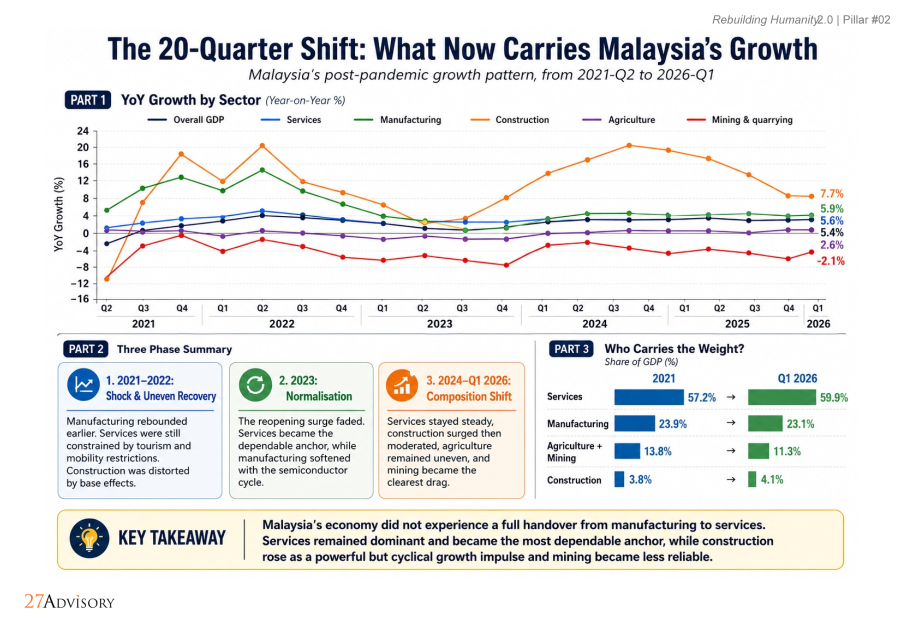
Three phases are visible across the last twenty quarters. The first, from mid-2021 into 2022, was reopening volatility, with construction posting growth above 40% in a single quarter simply because the prior year had been near standstill, then contracting more than 20% two quarters later as that comparison flipped. Every sector moved in exaggerated swings during this period, not because the underlying economy had transformed, but because each quarter was being measured against a pandemic-distorted twin a year earlier.
The second phase, through 2023, was normalisation. The wild swings settled. Growth across most sectors fell into a calmer, more believable range, with manufacturing in particular cooling sharply as the global semiconductor cycle turned, dropping to near-flat and even slightly negative growth in three of that year’s four quarters. This was the point at which the post-reopening sugar high wore off, and the real shape of the recovery became visible for the first time.
The third phase, from 2024 into Q1 2026, is the one that matters most for understanding where Malaysia stands today, and it is not the phase most people assume it is. The popular instinct is to say manufacturing used to carry the country and services has since taken its place. The data does not support that story. Manufacturing’s share of total output held remarkably steady across the period, sitting around 22% to 24% of GDP in 2019 and at 23.1% again in Q1 2026. It did not lose its seat. What actually happened is quieter and, in its own way, more consequential: agriculture and mining together shrank from 14.4% of GDP in 2019 to 11.3% now, while services, already the largest sector before any of this began at 57.6% in 2019, expanded into some of the space the resource sectors left behind, reaching 59.9% by Q1 2026.
This is the real twenty-quarter story. Not a handover from one sector to another, but a slow erosion at the resource base, with an already-dominant services sector absorbing nearly all of the difference, while manufacturing held its ground and construction’s share, having dipped during the pandemic, gradually recovered. Q1 2026 sits at the latest point on that curve: services growing 5.6%, manufacturing steady at 5.9%, construction moderating from a high base to 7.7%, agriculture slowing to 2.6%, and mining now the only sector in outright contraction at minus 2.1%.

The mechanism behind each piece of this is distinct, and worth separating rather than folding into one repeated conclusion.
Services strengthened through the most ordinary channels an economy has: household spending, mobility, retail, food and beverage, accommodation, transport, and a growing layer of digital activity. Tourism-linked movement sits inside this channel rather than beside it. Malaysia recorded 10.6 million international arrivals in Q1 2026, its strongest first quarter on record, and that mobility shows up directly in transport and restaurant and hotel activity rather than as a separate story. None of this required services to displace anything. It simply required the sector to keep doing, at slightly larger scale each year, what it has done since before the pandemic.
Manufacturing’s resilience is real but narrower than its steady share suggests. The strength sits concentrated in electrical, electronic and optical products, tied to global demand for semiconductors and AI-related components, while other manufacturing subsectors have been less prominent. A sector can hold its overall share while becoming more dependent on a smaller number of subsectors carrying it, and that appears to be what has happened here.
Construction’s swings are project-cycle driven, not structural. The sector ran at double-digit growth from mid-2024 through early 2025, peaking above 20% in late 2024, as infrastructure, utilities, industrial buildings, data centres and housing projects moved through their heaviest build phases simultaneously. Growth normalising toward single digits as those projects mature is the expected next stage of that cycle, not a sign of cooling demand.
Agriculture’s unevenness has several separate causes moving at once: palm oil yields normalising after an exceptionally strong prior quarter, alongside ongoing softness in rubber and fisheries that the advance estimate flagged directly. This is not one story, but several smaller ones happening to land in the same sector at the same time.
Mining is where the mechanism is clearest and least forgiving. DOSM attributed the contraction to lower production in crude oil and condensate, as well as natural gas. This is the cleanest illustration in the dataset of why output and price are not the same thing. A barrel that is never pumped does not lift GDP, no matter what it would have sold for.
Bank Negara’s international reserves, which rose from US$126.6 billion at end-March to US$130.6 billion by end-May, belong in this picture as confirmation that external confidence held through the period’s volatility, not as a contributor to the growth figure itself. Reserves cushion a shock. They do not produce output.
What Malaysia should do with this
The purpose of reading GDP composition this closely is not to make the economy sound more complicated. It is to see where resilience now actually sits, where it is thinning, and what needs strengthening before the next shock arrives.
Services carries the largest share of daily economic activity, and its growth this quarter was not abstract. MIDA’s Q1 2026 approved investments totalled RM92.8 billion, with services accounting for RM60.8 billion, or 65.5% of the total. Within services, information and communications alone accounted for RM38.9 billion, driven heavily by data centre and cloud computing projects. This shows where deep capability is currently landing. The direction is also reinforced by the Global Services Hub tax incentive, introduced as an enhancement to the expired Principal Hub scheme, to anchor higher-value regional and global operations in Malaysia. The task ahead is widening this beyond data infrastructure into the broader retail, logistics and professional services base that does not yet carry the same investment weight.
Tourism sits inside that same services channel. Malaysia welcomed 10.65 million international visitors in Q1 2026, its strongest first quarter on record and about 22.7% of the Visit Malaysia 2026 target of 47 million arrivals. The campaign’s RM147.1 billion receipts target also means the question is not only how many visitors arrive, but how much value each visit generates. Budget 2026 moves partly in this direction, with individual income tax relief of up to RM1,000 for entrance fees to tourist attractions and cultural or arts programmes, as well as a tax deduction of up to RM500,000 for tourism project operators undertaking renovation and refurbishment works.
Manufacturing’s overall share has held steady, but its strength is concentrated. Chipbond’s US$200 million advanced packaging facility in Penang, opened in February 2026 for AI-related chip packaging, is a clear example of where capability is deepening. The task is widening that base across more subsectors, rather than letting one or two carry the sector’s resilience alone.
Construction’s recent double-digit run was a project cycle, not a permanent state, and it is already normalising. The standard going forward is whether projects add lasting productive capacity and connectivity that outlives the construction phase itself.
Agriculture’s unevenness needs targeted support. Oil palm and livestock continue to anchor the sector, while rubber and fisheries need their own attention, through instruments such as the Rubber Production Incentive, which has channelled over half a billion ringgit to smallholders since 2015, and new 13th Malaysia Plan schemes supporting fisheries financing and equipment replacement.
Mining is the clearest structural lesson here. Real GDP depends on physical output actually produced, not on what global prices imply that output would have been worth. The sector’s exposure to events outside Malaysia’s control is now a permanent feature of how it should be read, and Malaysia’s National Energy Transition Roadmap already points toward reducing that dependence.
Bank Negara’s reserves, which rose through the period’s volatility rather than draining from it, did their job as a confidence buffer rather than a growth engine. Preserving that buffer matters precisely because it gives the rest of the economy room to absorb a shock without a deeper crisis following.
None of this should be read as settled. This quarter’s resilience assumes a few things continue holding: that AI-linked chip demand keeps supporting manufacturing’s narrow strength, and that this year’s tourism momentum is not simply a Visit Malaysia 2026 campaign-year effect that fades afterward. Malaysia’s own Belanjawan 2026 projected full-year growth at 4.0% to 4.5%; Q1’s 5.4% is already running ahead of that, which is encouraging, but one strong quarter does not yet confirm that the rest of the year will hold the same pace.
Malaysia’s growth in Q1 2026 was real. The country does not simply need more of it. It needs to keep building from where its weight actually rests, and watch closely the places where that weight is thinning.
This article is part of 27Advisory’s Rebuilding Humanity 2.0 framework, a nine-pillar knowledge architecture for navigating Malaysia’s most consequential structural transitions. The issues explored in this piece connect directly to Pillar #02: Radical Fiscal & Governance Reset. To explore 27Advisory’s sectoral research and advisory work, visit our Rebuilding Humanity 2.0 page