

Somewhere in Malaysia this month, a family is looking at a renewal notice for their medical insurance and doing arithmetic they did not expect to be doing. The premium has jumped again. They can keep paying and cut something else from the budget. They can downgrade to a plan with a lower limit or a bigger co-payment. They can switch insurers. Or they can let the policy lapse.
Downgrading cover or letting a medical card lapse does not make the need for treatment disappear. When someone in the family falls sick, they still need answers to three questions: where to go, whether the care is available, and whether they can afford it. Keeping insurance within reach solves only half the problem. Public capacity has to grow too, in case more people must rely on the public system after their private cover lapses.
Let us start with affordability. Bank Negara’s interim measures, in place since December 2024, do not cap every premium at 10%. What they do is spread out repricing caused by medical claims inflation over a minimum of three years, through the end of 2026, which is expected to keep at least 80% of affected policyholders under 10% a year.
Policyholders aged 60 and above on their plan’s minimum tier get a one-year pause from their policy anniversary, though this does not apply to those on higher tiers or to increases from moving age bands.
Anyone whose policy lapsed in 2024 due to repricing could apply to reinstate it without fresh underwriting, but that window closed on 31 August 2025. Anyone facing this decision today should ask their insurer what options remain open.
Insurers were also required to offer alternative products at the same or a lower premium by the end of 2025. Policyholders can now ask their insurers about those alternatives.
These measures buy time. They do not fix the underlying cost curve. RESET, the joint MOH-MOF-BNM strategy, is trying to address that curve more directly through a reference price guide for common private procedures published by the insurance and takaful industry in January 2026, and a shift toward diagnosis-related group payment meant to make hospital billing more predictable.
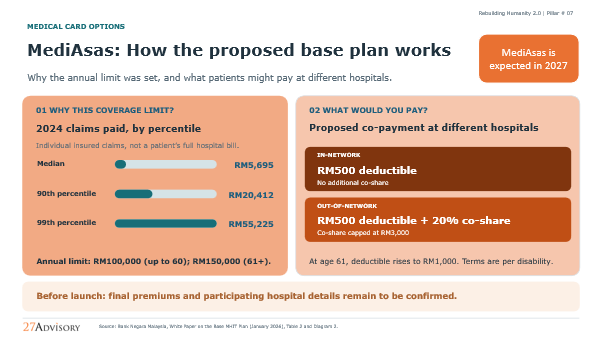
Whether these measures will slow medical inflation is still an open question. Medical inflation is projected at around 16% for 2026, one of the highest rates in the region. A lower premium today is not the same thing as coverage a household can afford to keep for the next ten years, and that second test is the one that matters more. MediAsas, the standardised base plan, is being piloted through 2026 ahead of a nationwide launch in 2027.
It will give Malaysians another coverage option, though the final premiums have not yet been set. The plan is meant to lower the cost of entry into private cover and open the door to people with stable, well-managed pre-existing conditions, subject to underwriting rules and waiting periods. Some conditions (including dengue, influenza and pneumonia) are proposed for outpatient cover when hospital admission is not clinically required. Initially, that cover would apply at hospital outpatient departments; extending it to participating private GP clinics remains a future possibility. MediAsas complements public healthcare. It does not remove the need for public hospitals to treat patients whose care exceeds what the plan can provide.
Bank Negara’s White Paper records the scale of surrenders and cancellations: roughly 340,000 MHIT policies were surrendered or cancelled between January 2024 and June 2025, equivalent to about 5.2% of repriced policies. That is a policy count, not a people count. It does not tell us whether those policyholders bought new cover, paid privately, delayed care or turned to the public system.
Malaysians remain eligible for heavily subsidised public healthcare whether they are insured or not. Outpatient charges can still be as low as RM1 under fees unchanged for more than four decades. But a low price at the door does not tell a patient whether treatment is available behind it. That is the harder test.
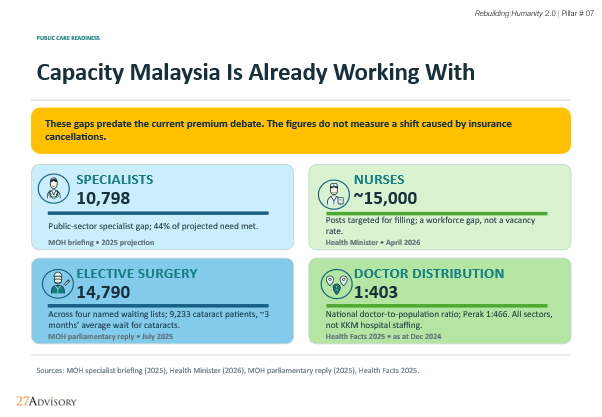
For non-emergency care, someone without private cover can start at a Klinik Kesihatan, where they can be assessed and referred for specialist or hospital care if needed. Anyone facing a medical emergency should go directly to an emergency department. That route sounds straightforward, but each step depends on the staff and time available to see the patient. MOH’s own 2025 data puts the public sector’s specialist shortfall at 10,798 doctors, with only 44% of stated need met and the largest gaps in cardiothoracic surgery, forensic pathology and family medicine. The Health Minister has described the nursing shortage as critical, with a gap of roughly 15,000 nurses.
These shortages predate insurance repricing. Any new demand, whatever its source, must be absorbed by the same constrained workforce and facilities. If more policyholders turn to public care, premium increases will not have caused the strain. They will have added to it.
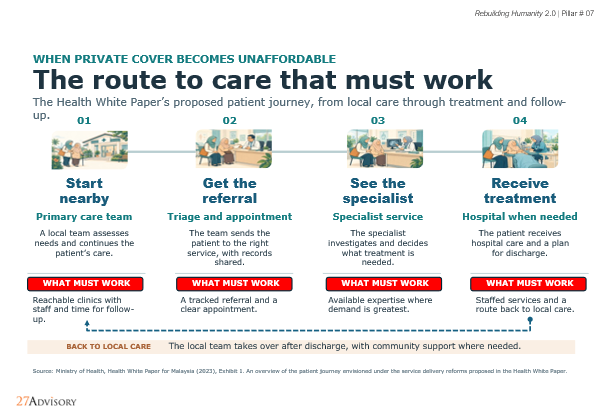
The four pillars of the Health White Paper already give Malaysia a strong reform frame. One part of that frame is a shift towards stronger primary care, under which each person would be linked to a regular primary care team near home or work, with referrals coordinated when more specialised treatment is needed.
But a plan is only as real as the patient journey it actually produces. Can the clinic see someone without a long wait? If specialist care is needed, does the referral lead to a facility that provides it, with an appointment the patient can actually attend? If hospital treatment follows, are the staff, equipment and space there to deliver it? A stronger front door only matters if the doors behind it open too.
The next task is to make implementation visible at the service level. MOH needs to know where referrals are backing up, which services are short-staffed and why patients are waiting: for a specialist, an operating theatre or a follow-up appointment.
England offers a useful model here, not a perfect one. NHS England (one of the UK’s four devolved health systems) publishes monthly referral-to-treatment waiting-time data by hospital and specialty, alongside separate data on diagnostic waits. Patients can also check estimated waiting times through the NHS App. England still has long queues. It has not solved the problem. What it has done is make the problem visible, down to where it is happening.
That visibility is what lets the response change by place and by service. One area might need more primary care staff. Another might need faster access to diagnostics. A third might need a way to move patients when the hospital they were referred to cannot treat them in time.
Beyond primary care, the Health White Paper also proposes sharing resources across hospitals and buying selected services from private providers when public capacity falls short. It envisages a defined health benefit package at an affordable cost, backed by a dedicated health fund. These are long-term reforms. When the White Paper was published, both the fund and the benefit package were still proposals.
The immediate challenge for MOH is making sure the required service is there, coordinating the referral and being clear about who pays if the patient must be treated in a private hospital. Without that coordination, a referral letter can point to a destination. It cannot make the treatment available or affordable.
In the end, letting a medical card lapse should not mean letting treatment lapse along with it. If private hospital care is out of reach, a patient still needs to know where to go and trust that care will not stop halfway. For the family doing the arithmetic today, that is the most basic protection the health system owes them.
This article is part of 27Advisory’s Rebuilding Humanity 2.0 framework, a nine-pillar knowledge architecture for navigating Malaysia’s most consequential structural transitions. The themes explored in this piece connect directly to Pillar #07: Secondary Healthcare & Care Economy, which examines how Malaysia builds the human, institutional, and financial infrastructure required to serve an ageing population while transforming care into a productive economic sector. To explore 27Advisory’s sectoral research and advisory work, visit our Rebuilding Humanity 2.0 page.