

Someone in Malaysia's construction industry made a decision this week that will affect people who have no idea it happened.
Not a policy announcement. Not a press release. A quiet, private decision , made by a contractor, a developer, or a project manager sitting with a spreadsheet that no longer adds up. They delayed the procurement. Or revised the scope downward. Or decided, finally, that the numbers cannot be made to work.
And somewhere, a family is still waiting for a key.
This is what a construction cost crisis looks like from the inside. Not dramatic. Not sudden. Just a thousand small decisions, made under pressure, that accumulate into something that eventually changes lives.
Malaysia’s construction costs are not going back down. That is no longer a forecast or a fear, it is the assessment of the profession’s own leadership. In his first official act as newly elected President of Pertubuhan Akitek Malaysia, Ar. Dexter Koh Yew Peng said what the industry needed to hear plainly:
” The industry must accept this reality and adapt to this new baseline.”
First act. Not a celebration. Not a vision statement. A crisis response.
When building materials account for 64.2 percent of everything [1] it costs to construct a building, any sustained upward movement in prices is not a boardroom problem. It is a site problem. A contract problem. A family-waiting-for-their-key problem.
Large firms have cushions: variation-of-price clauses, cost-plus arrangements, contingency buffers negotiated into contracts signed in better times. They will feel this. But they will absorb it.
The smaller contractors will not. The specialist subcontractors. The sole-proprietor firms that quietly hold the industry’s middle together , the ones nobody thinks about until a site goes quiet.
They have no cushion.
They have this month’s diesel bill and a contract that was priced six months ago.
How Big Is the Cost Pressure?
According to data from the Construction Industry Development Board cited by Economy Minister Akmal Nasrullah in late April 2026[2], the average increase across seven key building materials, namely bitumen, concrete, sand, aggregate stone, steel, and bricks, stands at 12.59 percent. Cement showed the most modest movement among the materials tracked, though May 2026 data from Business Today indicates it too has begun to rise, up 1.3 percent from March to April, suggesting the earlier relative stability may be short-lived.
The primary driver is not a single cause but a convergence of pressures: rising logistics costs following diesel subsidy rationalisation, and choked shipping routes from ongoing geopolitical tensions in the Middle East. Neither pressure is expected to resolve quickly.
Yet the 12.59 percent figure, real and government-confirmed as it is, does not capture what those on the ground are feeling. Industry players and contractor associations have reported material cost increases of between 20 and 40 percent [3] with some estimates reaching higher when specific materials in specific locations are examined. Diesel prices rose from RM2.99 per litre in February 2026 to RM5.52 per litre by the end of March[4], an increase of approximately 85 percent that flows directly into the cost of transporting every tonne of sand, steel, and stone to every site in the country.
The gap between the government’s 12.59 percent and the industry’s higher figures is not a dispute about honesty. It is a difference in vantage point. The national average looks across all materials, all locations, and all time. The contractor in Johor ordering sand this week is living in a different number. And both
numbers are true. What matters now is not which figure is correct, but what the government, the profession, and the industry intend to do about the reality
both figures describe.
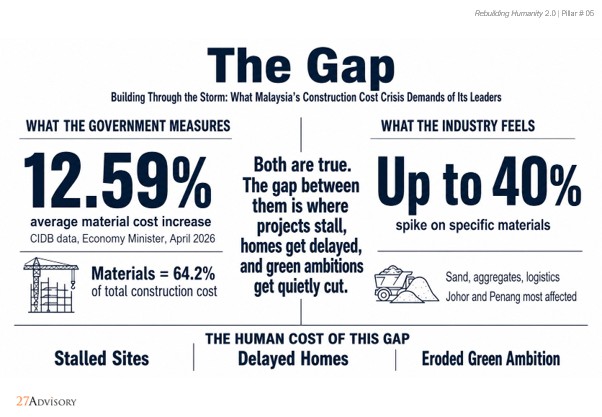
Infographic 1: The Gap
The Cost of Inaction
If nothing is done, or if the response comes too slowly, the damage will extend far beyond eroded contractor margins.
When construction costs exceed what a contract allows a developer or contractor to recover, the sequence of consequences is predictable. First comes delayed procurement and forced scope revision. Then compressed timelines and compromised quality as cheaper alternatives are sought. And in the most severe cases, the developer walks away entirely.
Project abandonment in Malaysia is not hypothetical. It has happened in previous economic cycles, and its most devastating impact falls not on institutions but on people. Specifically, the homebuyers who have already signed, already paid, and are left servicing loans against buildings that may never be completed. These are largely young families and first-time buyers, for whom a home represents not just an address but a decade of savings and the foundational act of building a life.
There is a second, quieter consequence that risks being overlooked in the urgency of the moment. As developers and contractors fight for margin survival, the features most likely to be cut from projects are the green ones: the sustainable materials, the energy-efficient systems, the design elements that cost more
today but deliver value over a building’s lifetime. The 2026 Saint-Gobain Sustainable Construction Barometer records that 71 percent of Malaysian
citizens[5] consider sustainable construction a priority. The cost crisis, left unaddressed, is the single greatest threat to delivering on that expectation.
What Needs To Be Done Now
PAM has not waited for others to move first. Alongside its cost escalation advisory, the institute has called on local governments to expedite planning and building approvals, and offered to work directly with the Ministry of Local Government Development to identify where fast-tracking is possible. Targeted discounts on submission fees and development charges have also been proposed. In a high-interest-rate environment, time is money, and every month saved in the approvals process is a month of holding costs that does not need to be passed on to the buyer.
Three responses deserve particular urgency.
1) Contractual Relief Through the VOP Clause. The Works Ministry has proposed reviving the Variation of Price clause for active government projects[6], a mechanism that allows contract sums to be adjusted when material prices move beyond a defined threshold. As of May 2026, this proposal is pending submission to the Ministry of Finance and the Ministry of Economy. It has not yet been enacted. But the logic is urgent and sound. Contractors administering projects under the PAM Form of Contract cannot indefinitely absorb cost shocks that were neither foreseeable nor within their control. A contractual safety net, activated swiftly, is the difference between a site that continues and one that quietly stops. For contractors facing immediate cash flow pressure, the government’s existing loan rescheduling options under the Syarikat Jaminan Pembiayaan Perniagaan Berhad scheme offer a parallel avenue of relief worth exploring without delay.
2) Expedited Approvals as Economic Stimulus. Every week a development sits in an approvals queue is a week of financing costs, holding costs, and opportunity costs accumulating against a project already under material price pressure. PAM’s call for fast-tracked approvals is not a request for regulatory shortcuts[7]. It is a recognition that bureaucratic timelines designed for stable economic conditions become disproportionate burdens in a crisis. Reducing approval cycles from the traditional 24 to 36 months toward a target of 12 months would provide meaningful relief without a single ringgit of government expenditure.
3) Import
Review as a Market Signal. The Sun
Malaysia reported that the government is considering relaxing import rules for
construction materials as one measure to curb rising costs[8].
No formal policy decision has been confirmed as of the date of this
publication. This remains a signal, not a resolution. But signals matter. When
government indicates that domestic pricing structures are under scrutiny, it
shifts the behaviour of suppliers and logistics players who have operated with
limited external competition. The conversation itself is a form of pressure,
even before any conclusion is reached.
[6] https://www.malaymail.com/news/malaysia/2026/04/11/govt-to-consider-reviving-price-variation-clause-as-construction-costs-surge-says-deputy-works-minister/215880
[7] https://www.pam.org.my/images/press/2026-27-council-term/PR_PAM_Calls_for_Collaborative_Action_to_Manage_Construction%20Cost_Escalation_Final260430.pdf
[8] https://thesun.my/news/malaysia-news/government-may-relax-import-rules-to-curb-construction-costs/
What the World Has Already Learned
Malaysia is not the first country to face a construction cost crisis of this nature. Three international responses offer practical lessons, not as distant ideals, but as tested approaches worth adapting now.
- Singapore: Build Smarter, Not Just Cheaper. The Building and Construction Authority’s Integrated Digital Delivery framework connects all stakeholders across a building’s entire lifecycle, from design through fabrication, construction, and asset management, using a unified digital approach. The result is measurable reduction in material waste, coordination errors, and rework, all of which become exponentially more expensive in a high-cost environment. The CanningHill Lighthouse development stands as a completed, documented example of IDD applied at scale. For Malaysia, the lesson is this: efficiency is a long-term answer to cost volatility. When you build smarter, you are less exposed to the price of any single material.
- The United Kingdom: Shift the Conversation From Cost to Value. Through the Royal Institution of Chartered Surveyors’ Building Cost Information Service and BIM Level 3 implementation, the UK construction sector has developed tools to model a building’s cost profile across its entire operational lifetime, sometimes extending to 50 years and beyond. Decisions that appear expensive at the tender stage can be demonstrated to be economical over time. For Malaysian policymakers and developers navigating a crisis that tempts cost-cutting, the UK model offers a reframing: the question is not what does this building cost to build, but what does it cost to own, operate, and maintain across its useful life.
- Australia: Govern the Pipeline, Not Just the Projects. Australia’s infrastructure governance framework applies a discipline that becomes essential during cost surges: strategic prioritisation of the project pipeline rather than attempting to fund everything simultaneously at reduced quality. When material and labour costs exceed critical thresholds, the response is not to dilute all projects equally but to rank them, sequence them, and protect the most critical. For Malaysia, whose Budget 2026 commits RM81 billion to development expenditure within a record RM470 billion allocation, the lesson is this: fiscal ambition and fiscal discipline are not opposites. Choosing which projects proceed is not a failure of commitment. It is the responsible exercise of leadership under constraint.
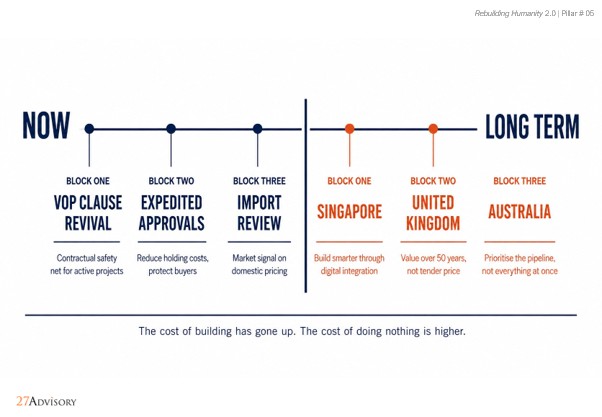
Infographic 2: What can we do now & global learnings
The Human Thread
Behind every percentage point in this article is a person.
The contractor who built his business across two decades of Malaysian projects, who knows his suppliers by name, who has delivered on time through previous recessions, now watching his margins dissolve in a single quarter of diesel price increases he did not cause and cannot control.
The architect asked to redesign for the fourth time without additional compensation, because the budget has changed again and the client cannot afford what was specified three months ago. PAM has named this reality directly, calling upon clients including government agencies and GLCs to uphold statutory fee requirements and equitable payment milestones. It is a call for professional dignity inside an economic crisis.
And the young couple in Setia Alam or Ara Damansara who signed their sale and purchase agreement two years ago, who have been paying their loan since before the building reached the third floor, and who are still waiting for the key that represents everything they have worked toward.
The cost crisis is not an abstraction. It lives in these people’s daily calculations.
The decisions made in the coming months, by government, by industry, and by the profession, will determine whether their patience is rewarded or whether
Malaysia adds another chapter to a history of abandoned projects and broken promises it can ill afford to repeat.
What The Moment Demands
PAM’s first act under new leadership was not a ceremony. It was a call to the profession to stand in the gap, to be fair administrators, collaborative problem-solvers, and protectors of the public interest, at the moment when doing so costs something.
That is not a small thing.
Malaysia does not need more reports about what sustainable, affordable, well-built housing should look like. It needs the people with the knowledge, the relationships, and the professional standing to make hard decisions now, in the middle of a crisis, without waiting for conditions to improve.
The cost of building has gone up. The cost of doing nothing is higher.
Build anyway. Build wisely. Build together.
This article is part of 27Advisory’s Rebuilding Humanity 2.0 framework, a nine-pillar knowledge architecture for navigating Malaysia’s most consequential structural transitions. The themes explored in this piece connect directly to Pillar #05: Infrastructure, Water & Climate Resilience.
To explore 27Advisory’s sectoral research and advisory work, visit our Rebuilding Humanity 2.0 page.
This article was originally published on 19 May 2026. Following the relaunch of our website, we are re-publishing our Article section covering the nine pillars of Rebuilding Humanity 2.0 (RH2.0).