

As Sarawak develops health facilities for an ageing population, its workforce gap will determine how much care those facilities can actually deliver to patients.
In 2025, Malaysia’s Ministry of Health offered permanent placements in Sarawak to 764 contract medical officers, more than in any other state. By November, only 432, or 57 percent, had reported for duty. The remaining 332 had either not reported for duty or declined the placement by that point. The figure does not represent doctors resigning after a difficult posting. It captures the failure to convert permanent appointment offers into doctors serving on the ground.
A Pattern, Not an Anomaly
According to the Health Minister’s written reply to the Dewan Negara in December 2025, one of the ministry’s main challenges was the willingness of staff to accept designated placements, particularly in rural and remote parts of Sarawak. The problem is therefore not only how many doctors Malaysia trains, but whether enough of them accept placements and remain in the places where they are most needed. The minister noted that this pattern is not unique to health. The Ministry of Education faces the same difficulty, with teachers also declining postings to Sarawak.
This detail matters. A recruitment problem confined to one ministry might point to something specific to how health postings are managed. A pattern repeated across ministries points to something broader about what it takes to attract skilled professionals to rural Sarawak, and to keep them there once they arrive.
For patients, the consequence is immediate and local. Every approved post that remains vacant reduces the capacity a facility can deliver, even when the building itself is open. Existing staff must absorb the uncovered workload, while appointments, operating hours or access to particular services may become more constrained.
When a Permanent Post Is No Longer Enough
Nationally, the share of medical officers who did not report for permanent posts rose from 2.4 percent in 2022 to 20.4 percent in 2023. In Sarawak, 43 percent of those offered permanent placements in 2025 had not reported for duty. That deterioration began before the latest revision to the Regional Incentive Allowance, so it cannot be attributed to one policy alone. Yet the change matters because it altered the terms offered to new recruits precisely when acceptance rates were already weakening.
Under the Public Service Remuneration System, management and professional officers appointed from December 2024 receive a fixed RM360 monthly allowance for service in Sabah, Sarawak and Labuan, while earlier appointees retain their last-drawn amount under the previous structure. The Malaysian Medical Association and Malaysian Dental Association have called for the progressive allowance to be restored, with MMA estimating an annual cost of about RM4.2 million. The government is correct that existing officers did not lose their previous rate. The recruitment question, however, concerns whether the terms offered to new appointees are sufficient to persuade them to relocate and remain.
The government has since introduced full relocation support for eligible doctors taking permanent placements and given the Ministry of Health direct control over the allocation of its approved posts. Both measures reduce practical barriers to placement, although it is still too early to know whether they will materially improve reporting and retention rates.
An Ageing State Meets a Persistent Workforce Gap
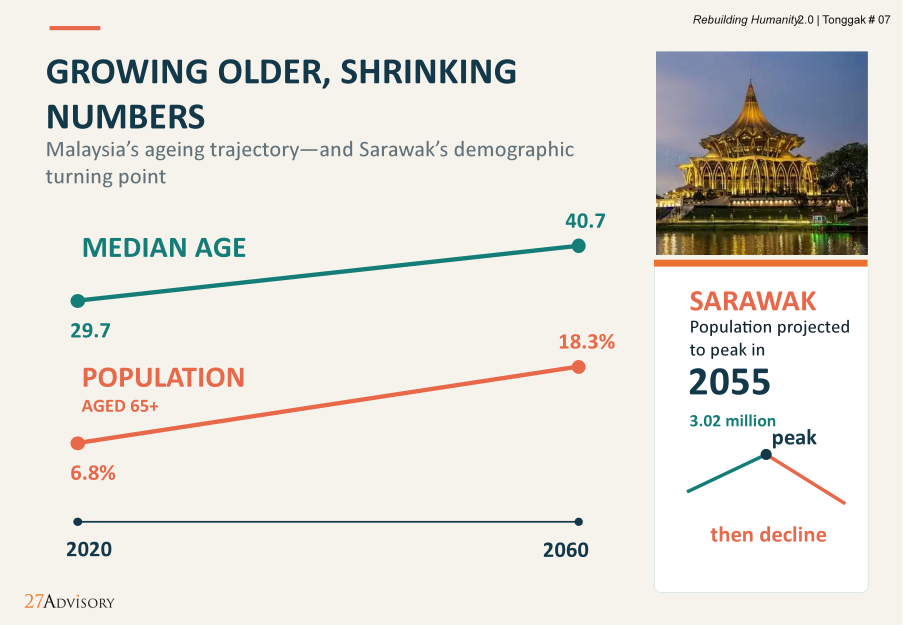
This staffing gap is opening as Sarawak’s demographic profile shifts under it. According to DOSM’s Population Projections, Malaysia, 2020–2060 (released July 2025), the national median age is projected to rise from 29.7 years in 2020 to 40.7 years by 2060, while the share of Malaysians aged 65 and above is expected to nearly triple, from 6.8 percent to 18.3 percent. DOSM’s national report does not publish a separate median age projection for Sarawak. What it does show is that Sarawak already meets the threshold of an ageing state, with more than 7 percent of its population aged 65 and above as of 2024 to 2025, and that the state’s total population is projected to peak around 2055 at roughly 3.02 million before it begins to decline.
That combination, a population that keeps growing older even as its overall size stops growing and then falls, is a harder planning problem than growth alone. Sarawak will need more of the recurring, specialist and long-term care an older population requires, delivered to a population base that will eventually be smaller, not larger. Demand is shifting in both size and kind. Workforce supply has yet to keep pace with that shift.
The Numbers Behind the Gap
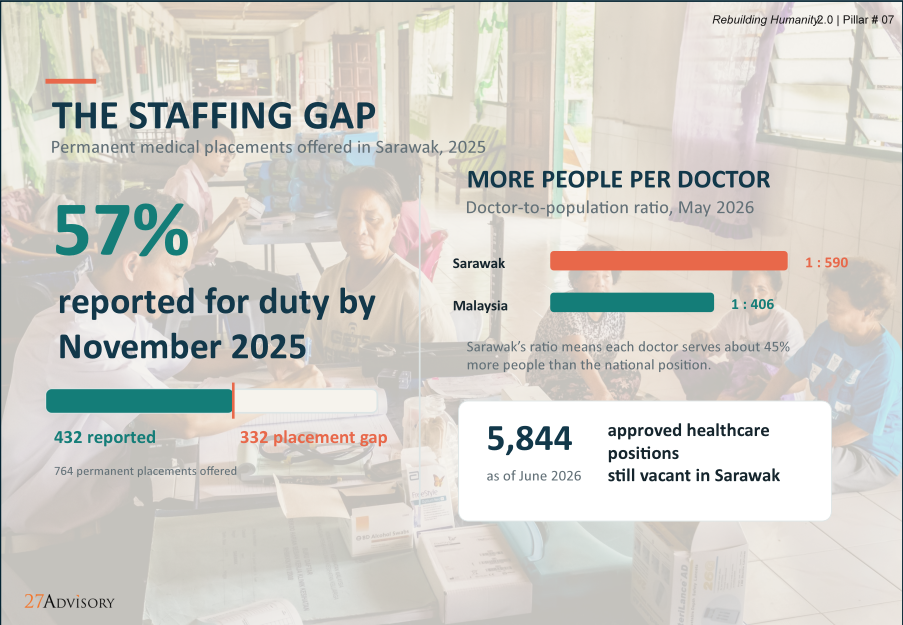
Even before accounting for doctors who never reported for duty, Sarawak’s workforce numbers already trail the national position. As of May 2026, the state recorded approximately one doctor for every 590 people, compared with one for every 406 nationally. Some 5,844 approved healthcare positions in Sarawak also remained vacant as of June 2026.
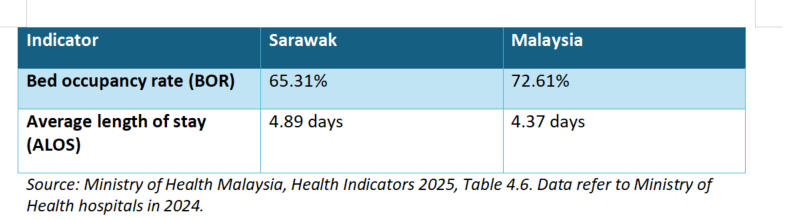
Hospital utilisation data provides another view of how capacity is distributed. In 2024, Ministry of Health hospitals recorded the following figures:
At first glance, Sarawak’s lower occupancy rate may appear to indicate spare capacity. However, the state-wide averages combine hospitals with very different functions. Sarawak General Hospital recorded an occupancy rate of 88.54 percent, while several smaller district hospitals operated below 50 percent. The state’s longer average length of stay is also influenced by specialist long-stay institutions. Hospital Sentosa, which provides psychiatric, rehabilitation and forensic services, recorded an ALOS of 154.64 days, while Rajah Charles Brooke Memorial Hospital recorded 49.10 days. These institutions are not directly comparable with acute hospitals. Their inclusion nevertheless reveals that part of Sarawak’s hospital system is also carrying long-term care functions. As the population ages, the need for psychiatric, rehabilitation, residential and community-based care will become increasingly important alongside the need for acute hospital capacity.
Building Sarawak’s Hospitals, Carefully
Investment is moving, although Sarawak’s major health projects remain at different stages of development. Hospital Petra Jaya is intended to begin operating in phases following its handover, while the proposed new block at Hospital Sibu and the planned 76-bed hospital in Lundu remain at earlier stages. The Sarawak Cancer Centre is being developed separately. Infrastructure improvements are also extending beyond physical construction. By May 2026, 176 primary healthcare facilities in Sarawak, or 65.2 percent of the total, had been digitised, with another 94 at various stages of implementation.
In May 2025, the Sarawak government estimated that RM17.26 billion would be required to upgrade and redevelop health facilities across the state: RM8.01 billion for clinics and RM9.25 billion for hospitals. The figure represents an assessment of need, not a confirmed federal allocation under the 13th Malaysia Plan. More importantly, it captures only the physical investment required. The workforce needed to operate those facilities would still have to be recruited and retained.
Two Different Kinds of Capacity
A completed hospital is not necessarily the same as staffed capacity. Vacant posts can limit the number of beds, clinics and specialist services that a facility is able to operate, while increasing the burden carried by its existing workforce. Capital budgets are counted in ringgit and square footage. The capacity a patient actually experiences is counted in whether a doctor is present, whether a specialist clinic runs on schedule, and whether a rural clinic is open for the hours it claims to be.
The Workforce Plan Behind the Building
Malaysia already has some tools aimed at this problem. Medical and dental specialists posted to Sabah, Sarawak and Labuan receive a monthly incentive of between RM500 and RM2,500, while postings to Sarawak’s interior carry a separate location allowance of RM500 to RM1,500 a month. The state has also invested in its local medical pipeline through Yayasan Sarawak, which funds 40 scholarships annually for eligible Sarawakian students pursuing medicine at UNIMAS. These measures recognise both the additional difficulty of serving in particular locations and the importance of developing more doctors locally. Yet the 57 percent reporting rate suggests that financial incentives and training pipelines alone have not resolved the placement challenge.
International experience suggests that locally rooted medical training works best as a package rather than through financial incentives or compulsory service alone. Thailand’s special rural track recruits students from rural backgrounds, provides clinical training through provincial hospitals and includes regulated local service. Some 78.2 percent of its graduates remained in the public health service, compared with 52.5 percent from the conventional track. Japan’s Jichi Medical University combines tuition support with nine years of service in graduates’ home prefectures, including rural placements. Even after completing that obligation, 69.8 percent remained in their home prefectures for at least another six years.
Sarawak already has the beginnings of such a pipeline through the 40 medical scholarships funded annually at UNIMAS. A pilot programme could build on it by recruiting students from underserved districts, expanding rural clinical training and offering guaranteed Sarawak placements supported by housing, career development and specialist pathways. A proportionate return-of-service requirement could form part of that package, but the aim should be long-term retention rather than short-term compliance.
Every major hospital or clinic investment in Sarawak should come paired with a funded workforce-readiness plan. That plan should also revisit the Regional Incentive Allowance structure itself, alongside recruitment pipelines built well ahead of a facility’s completion date, housing for posted staff, predictable rotation schedules, clear pathways to specialist training and career progression, real consideration for staff with families, and relief arrangements so existing staff are not left indefinitely covering the gap left by colleagues who never arrived.
Measuring What Matters
It would also help to measure the right things publicly. Announcements currently emphasise ringgit committed and beds installed. A clearer picture would track staffed beds, not only installed ones, filled rosters against approved establishment, how long specialist vacancies stay open, clinic operating hours actually delivered against those advertised, the rate at which offered placements are accepted, and how many appointees remain in post after 12 and 36 months. Published consistently, these measures would show the public and the agencies planning the next five years of investment whether expenditure is translating into care delivered.
Building Capacity That Can Be Staffed
Sarawak needs the hospitals and clinics now being planned and developed. Yet an ageing population will not be served by concrete and steel alone. Infrastructure readiness and workforce readiness must be planned, funded and measured together. Otherwise, new facilities may add capacity on paper without delivering the corresponding increase in care. A hospital becomes capacity only when the people needed to run it are there.
This article is part of 27Advisory’s Rebuilding Humanity 2.0 framework, a nine-pillar knowledge architecture for navigating Malaysia’s most consequential structural transitions. The themes explored in this piece connect directly to Pillar #07: Secondary Healthcare & Care Economy, which examines how Malaysia builds the human, institutional, and financial infrastructure required to serve an ageing population while transforming care into a productive economic sector. To explore 27Advisory’s sectoral research and advisory work, visit our Rebuilding Humanity 2.0 page