
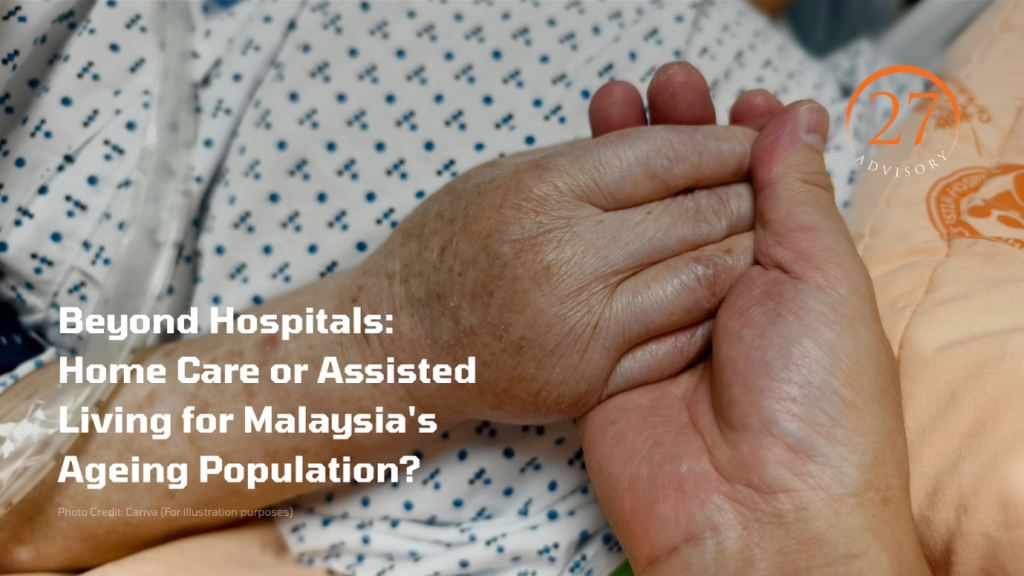
The hospital says Mak is well enough to be discharged. She is not, however, well enough to bathe safely, remember every medicine, or stay alone while her children work. The family now faces two apparent choices: bring care into the home, or move her into a residence that can provide daily assistance. Neither decision starts with medicine. It starts with a harder question: what care does she actually need, who can be trusted to give it, and how long can the family afford to pay.
This question is becoming ordinary in Malaysia, not exceptional. And the honest answer is that the country has more than one care model, but no reliable system connecting families to the right one at the right time.
Three Models, not two choices
Home care and assisted living are often talked about as if they were opposites. They are not. Home care means non-medical support with daily living: companionship, medication reminders, meals, hygiene and mobility, sometimes paired with separately arranged home nursing or rehabilitation. Assisted living means accommodation plus recurring help with daily activities, meals, housekeeping, supervision and social participation. It is not automatically a nursing home. Skilled nursing sits above both: continuous or complex clinical care, feeding tubes, complex wounds, advanced post-stroke needs, care that ordinary assisted living cannot safely provide.
Collapsing these three into one category, “old folks’ care”, is where most confusion starts. It also corrupts any comparison of price or quality, because a family comparing a RM3,600 home care schedule against a RM9,980 independent living package is not comparing like with like.
What the market actually charges
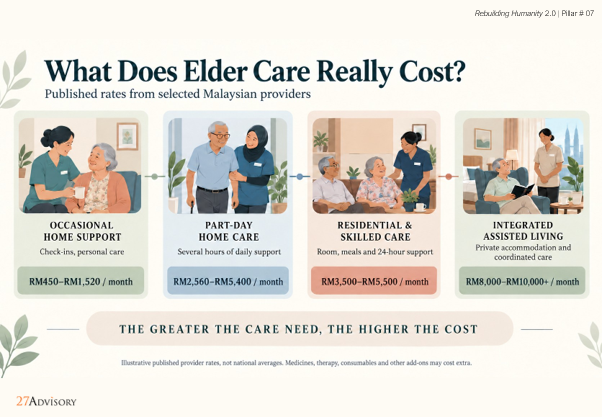
Provider rates in Malaysia should be read as market illustrations, not national averages, because no nationally representative price survey exists. In Kuala Lumpur, Selangor and Johor, Homage lists an 80-hour monthly personal-care plan at RM2,560 and a 150-hour plan at RM4,500; plans incorporating nursing support cost RM3,040 and RM5,400 respectively. Ad hoc care starts at RM45 an hour for personal care and RM60 for nursing. Seniora’s daytime caregiving, subject to a six-hour minimum, ranges from RM20 an hour in Taiping to RM30 in Penang, with higher rates at night. Residential packages advertised by My Aged Care begin around RM3,500 for economy care and RM5,000 for bedridden or critical nursing care. At the premium end, ReU Living advertises independent living from RM9,980 a month.
Measured against DOSM’s 2024 median gross household income of RM7,017 a month, Homage’s RM4,500 high-volume personal-care plan would absorb almost two-thirds of a median household’s income. A RM5,000 residential package would absorb roughly 71 percent. This is not only a B40 problem. It can overwhelm middle-income households too, and tax relief on eldercare expenses does little for a family that has no taxable income or no cash to pay upfront in the first place.
The policy is moving, slowly
Malaysia’s government has started calling long-term care a social security issue rather than pure welfare. In the Dewan Negara on 23 July 2026, KPWKM named the Malaysia Care Strategic Framework and Action Plan 2026 to 2030, set a target of training 50,000 skilled carers by 2030, and proposed public-private collaboration to expand home and day-care services. Budget 2026 raised senior welfare allocations to RM1.26 billion for about 180,000 beneficiaries. That number should not be mistaken for a long-term care subsidy. It mainly strengthens means-tested support for the poorest older Malaysians, not a general entitlement to home care or assisted living.
Regulation is also incomplete. Non-medical residential centres still fall under the Care Centres Act 1993, and clinical facilities under the Private Healthcare Facilities and Services Act 1998. The Private Aged Healthcare Facilities and Services Act 2018, meant to unify aged-care standards, was gazetted in 2018 but has not been brought into force. As of September 2026, sector reporting from the Malaysian Caregivers Association indicates it still awaits a ministerial commencement date and finalised regulations. Families today have no single, simple way to check a provider’s licence, staffing or scope of care.
Where a low-income family actually goes
This is the gap the policy conversation tends to skip. For a family with no money for private care, the documented public options are narrow and tightly gated. The Department of Social Welfare, JKM, runs two residential routes. Rumah Seri Kenangan, with eight facilities nationwide, is meant for older people who are poor but can still manage themselves, and requires no income, no permanent residence and no heirs or caregivers. Rumah Ehsan, with two facilities, serves frail or chronically ill older people who cannot self-care, under similarly strict “no heir, no income” criteria. In practice, this means an older person with children who exist, but cannot sustainably provide care, often does not qualify for either.
JKM’s other major programme, Pusat Aktiviti Warga Emas, is free and genuinely useful for reducing isolation, offering health screenings, light rehabilitation activities and social participation. But it is community programming, not personal care. It does not bathe anyone, manage medication or provide overnight supervision. Beyond these two tracks, no nationally documented JKM home-help service, comparable to scheduled personal-care visits or respite care, appears to exist. One targeted measure exists: the Bantuan Penjagaan Orang Kurang Upaya Terlantar, Pesakit Kronik Terlantar dan Pesakit Kronik Tidak Terlantar, or BPT, provides RM500 a month to eligible caregivers. KPWKM reported 42,036 recipients nationwide as at June 2026, with cumulative expenditure exceeding RM119.5 million. Its coverage extends to eligible non-bedridden chronic patients, but it remains a tightly targeted welfare payment subject to medical and financial eligibility rather than a general home-care subsidy for older persons experiencing frailty, falls or cognitive decline. Many families therefore begin carrying significant care responsibilities long before an older parent meets the scheme’s eligibility requirements.
NGO and faith-based homes, run by groups such as Ti-Ratana and various Buddhist, Christian and Muslim welfare societies, are a real route for some families. But access is fragmented and often opaque. There is no national registry of vacancies, fees or waiting times. A family has to contact individual homes directly and verify JKM registration itself. When a hospital discharges an older patient who is medically fit but cannot safely return home, the sources reviewed do not identify a nationally standardised pathway that reliably connects every such family to community nursing, step-down care or a JKM placement. What happens next may depend on the discharge arrangements made by the clinical team, the intervention of a hospital medical social worker and the capacity of local health and welfare services.
What Japan and Singapore did differently
Two countries offer a useful contrast, not because their systems can be copied wholesale, but because of the order in which they built things.
Japan introduced its mandatory public Long-Term Care Insurance system in 2000, funded through insurance contributions and taxation. It did not create eldercare services from nothing. Its importance lay in establishing a national entitlement, a standardised assessment of care needs and a predictable pool of funding through which eligible users could obtain approved services. This gave families clearer access to care and providers a more dependable source of payment.
Singapore introduced ElderShield in 2002 and later replaced it for younger cohorts with CareShield Life, a mandatory national insurance scheme providing lifetime cash benefits for severe disability. The payments do not necessarily cover the full cost of care, but they give eligible households some purchasing power and reduce their reliance on immediate income alone.
In both countries, care financing became part of the national social-protection architecture rather than being left entirely to individual families.
Malaysia’s emerging framework places substantial emphasis on expanding services, developing 50,000 skilled carers and encouraging public-private collaboration. These measures may improve supply and professional capacity. However, the sources reviewed do not identify a comparable nationwide mechanism that pools long-term-care costs or guarantees households an entitlement to funded care according to assessed need. This creates a sequencing risk. Training more carers will not by itself generate sustainable demand if most households cannot afford their services. Private investment is also likely to expand first in segments where customers already have purchasing power. Malaysia therefore needs to develop care capacity and care financing together: one builds the services, while the other determines whether ordinary families can actually use them.
Who is paying for longer lives right now
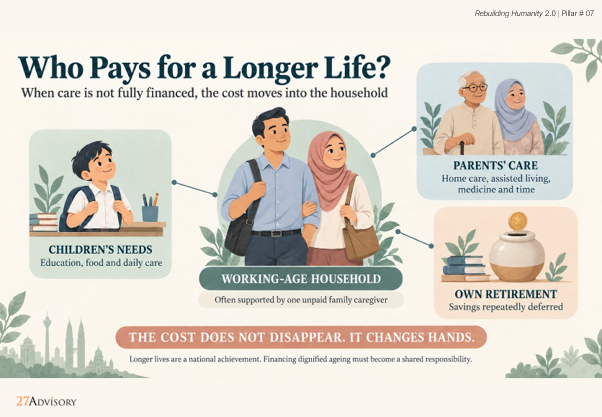
At present, the honest answer is Malaysian families, and inside those families, most often one adult child who absorbs the cost through reduced income, career sacrifice or their own exhaustion. Home is not automatically dignified if it depends on an unpaid caregiver providing unsafe lifting and night supervision alone. A residence is not automatically undignified if it offers privacy, competent support and continuity of relationships. The right setting is whichever one remains safe, humane and financially sustainable, with room to move to a higher level of care as needs change.
Reaching that point nationally would need a standard needs assessment so families are not guessing, a public registry of licensed providers with comparable service information, transitional care after hospital discharge, means-tested vouchers usable across home care, day care or assisted living, support for family caregivers, and protection against the kind of prolonged, high-intensity costs that can bankrupt an ordinary household. Malaysia is visibly building a care industry. Until it also builds a care-financing system, the answer to who bears the cost of Malaysians living longer will keep being the same one: their children.
This article is part of 27Advisory’s Rebuilding Humanity 2.0 framework, a nine-pillar knowledge architecture for navigating Malaysia’s most consequential structural transitions. The themes explored in this piece connect directly to Pillar #07: Secondary Healthcare & Care Economy, which examines how Malaysia builds the human, institutional, and financial infrastructure required to serve an ageing population while transforming care into a productive economic sector. To explore 27Advisory’s sectoral research and advisory work, visit our Rebuilding Humanity 2.0 page.