

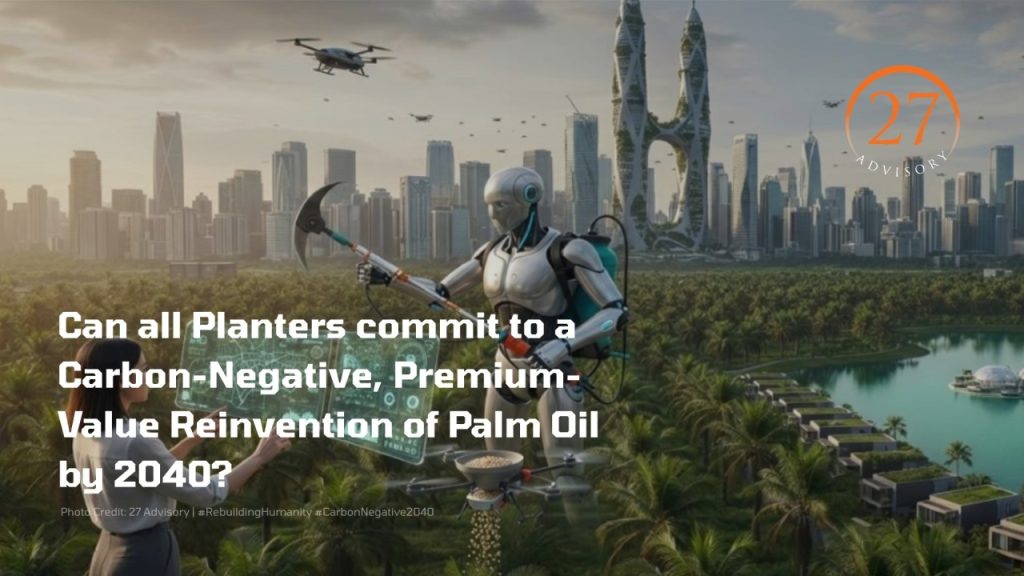
Why Malaysia’s Oil Palm Future Depends on Technology, Credibility and Scale
For much of the past two decades, palm oil has occupied an uncomfortable place in the public imagination, closely associated with deforestation, peatland loss and an environmental reputation the industry has struggled to overcome. Against this backdrop, Girish Ramachandran, CEO of IRGA, advanced a provocative proposition at the International Planters Conference 2026: oil palm plantations could become carbon negative by 2040. Is this merely an ambitious slogan, or does it point towards a genuine redesign of the plantation business? The answer depends on whether Malaysia is prepared to change where future growth comes from, how emissions are counted and how technology is deployed across the industry.
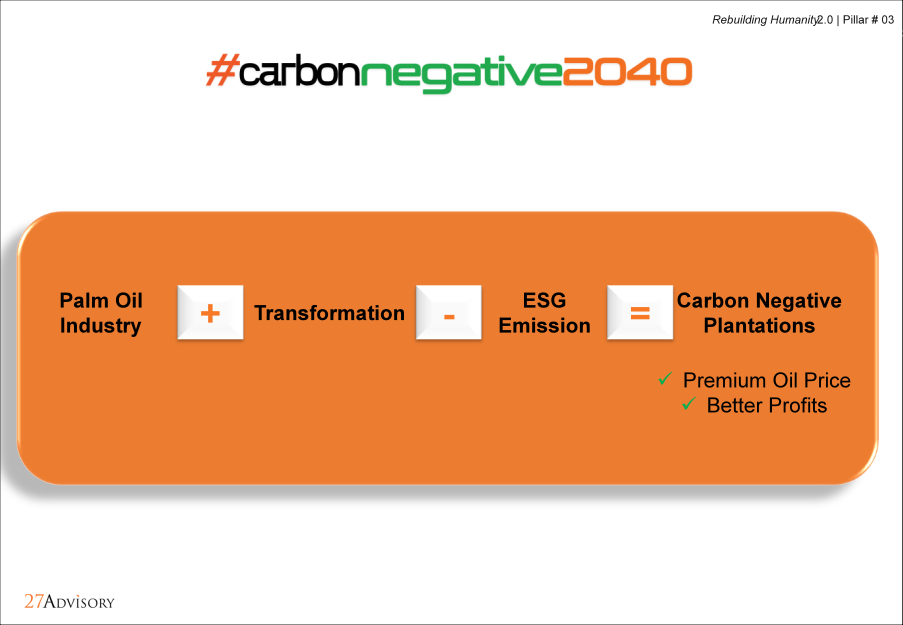
The proposition is not based simply on the fact that oil palms absorb carbon dioxide as they grow. Its deeper argument connects four pressures that are often treated separately: stagnant yields, wide differences in plantation performance, growing scrutiny of climate impacts and the industry’s persistent reputational problem. Closing the yield gap and reducing emissions across the plantation chain, from field to mill, are therefore not separate projects. They form part of the same operational transformation, with technology as a central enabler.
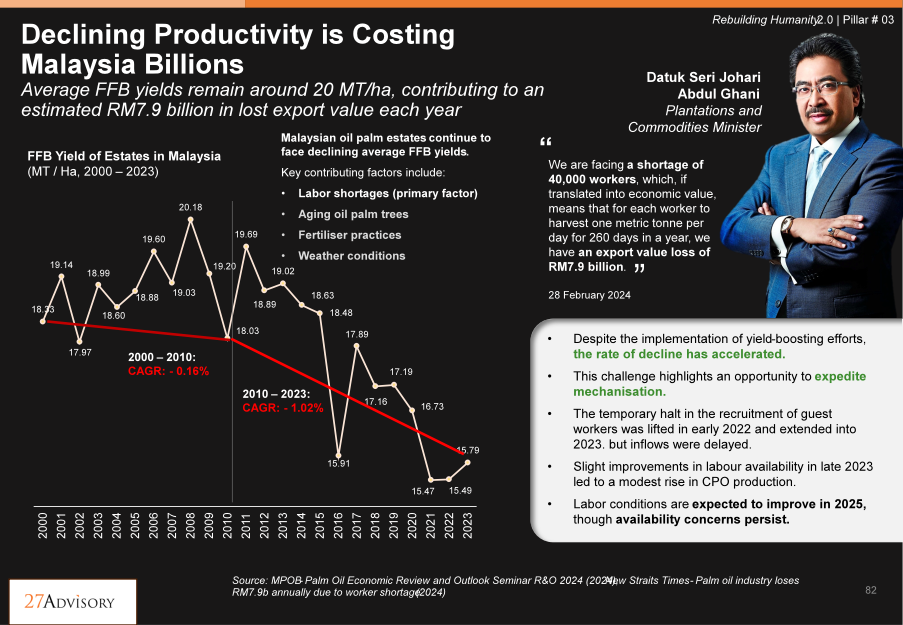
National fresh fruit bunch yield stood at about 15.8 tonnes per hectare in 2023 and improved to approximately 16.7 tonnes per hectare in 2024, still below Malaysia’s historical peak. The contrast with high-performing estates indicates substantial room for improvement through better planting materials, stronger agronomic practices, timely harvesting and more precise field management. Industry modelling suggests that even a modest improvement in national yield could produce a substantial increase in crude palm oil output without requiring additional planted area. As the yield gap narrows, the economic case for further expansion weakens, while the case for investing in existing plantations becomes stronger.
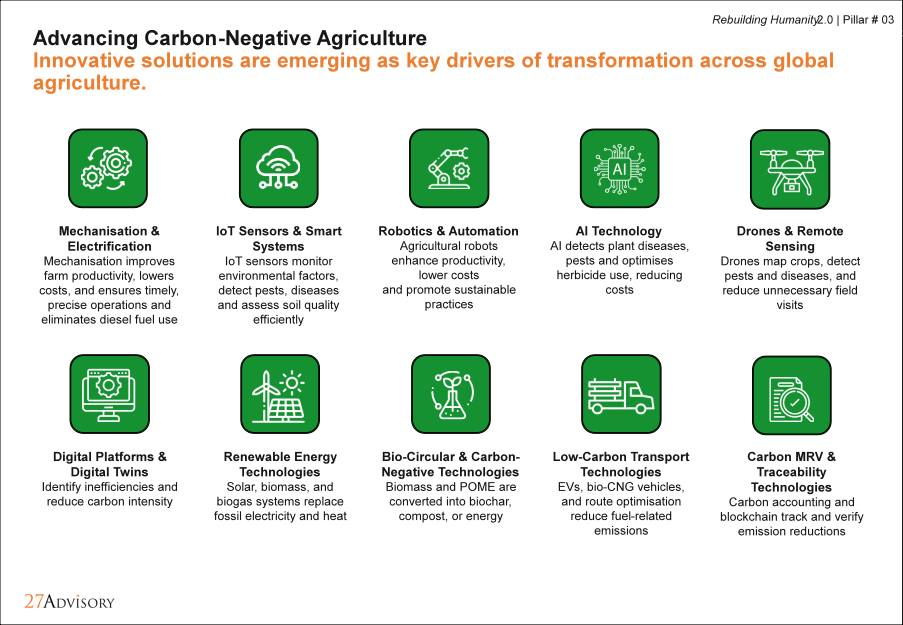
The technologies behind this are not uniformly proven, and that distinction must be stated plainly. Some technologies have already demonstrated measurable operational value. Motorised harvesting and evacuation equipment can improve worker productivity and ease persistent labour constraints, while methane-capture systems at palm oil mills can substantially reduce emissions and convert biogas into usable energy. Other technologies remain at an earlier stage of deployment. Drone-based crop monitoring and precision spraying show strong results in corporate trials and pilots, but their effectiveness has yet to be demonstrated at national scale. Integrated digital plantation platforms, similarly, have shown real gains in pilot settings, cutting the delay between harvesting and milling, which matters because that delay quietly erodes oil extraction rates. Distinguishing commercial deployment from pilot results and vendor claims is essential. Without that discipline, the technology agenda risks becoming a collection of promising demonstrations rather than a credible national strategy.
Even a fully optimised and highly mechanised plantation cannot establish carbon negativity on the strength of yield alone. A mature oil palm stand does sequester a meaningful amount of carbon dioxide as it grows. But biological growth is only one side of the ledger. The other side includes the legacy of how the land was cleared, whether fertiliser use generates nitrous oxide emissions, how much diesel and machinery combustion the operation depends on, and whether methane from mill effluent is captured or released. Land-use history is therefore central to the calculation. Plantations established on mineral soil, without recent forest or peatland conversion, generally carry a lower carbon footprint than plantations on drained peat. Plantations on drained peatland are a different story entirely: continuous microbial breakdown of the peat itself becomes a major, ongoing emissions source, and published life-cycle assessments put the carbon footprint of palm oil grown on peat several times higher than the mineral-soil figure. This is not a minor accounting issue. A credible carbon-negative claim must therefore be assessed at plantation level and supported by clear boundaries, land-use history and independently verified emissions data. Claims involving drained peat or recently converted forest land would be considerably harder to substantiate, regardless of downstream efficiency.
Read carefully, this condition strengthens rather than weakens the technology argument. If further conversion of forest and peatland is no longer an acceptable route to growth, particularly within Malaysia’s national planted-area cap of 6.5 million hectares, then yield and efficiency gains on existing land become the principal source of future growth. Protecting what forest and peatland remains does not compete with the technology agenda. It is the condition that makes the technology agenda necessary in the first place.
If technology is to become the industry’s next source of growth, the central policy question is no longer whether suitable tools exist, but whether Malaysia has a system capable of validating, financing and distributing them at scale. Malaysia is not starting from zero. It already has important building blocks. MSPO’s revised standard strengthens restrictions relating to forest conversion and new planting on peat, while MPOB conducts mechanisation research, field demonstrations and technical advisory work. Recent digital applications, replanting assistance and mechanisation funding also indicate that public institutions recognise the need for wider technology adoption. These measures show that the government has begun to respond. But available evidence does not yet show that these programmes have translated into broad field adoption, particularly beyond the largest and best-capitalised plantation groups. The gap is not between having no policy and having one. It is between announcing a programme and demonstrating that it has achieved meaningful adoption and measurable results in the field.
That gap points towards the article’s most important policy implication. Government does not need to invent every plantation technology. It needs the institutional capacity to test what already exists, verify vendor claims independently, and make validated tools accessible beyond companies large enough to fund their own research and development. That could mean an open testbed where the Malaysian Palm Oil Board verifies performance claims for mechanisation, sensors and AI tools before they reach the market. It could mean shared machinery hubs run through cooperatives or mills, so that smallholders access equipment on a pay-per-use basis rather than needing to own it. It could mean digital vouchers that let smallholders purchase verified services from a competitive field of providers rather than being steered toward any single company. The principle that matters is independence: public validation should provide a fair and transparent basis for identifying technologies that are effective, suitable and ready for wider adoption.
Independent smallholders are a genuine test of whether this transformation reaches the whole country rather than only its most capitalised corner. They cultivate a meaningful share of Malaysia’s planted area, typically on relatively small holdings, and often face limited replanting capital, ageing farm operators and insufficient transparency in grading, weighing and pricing across intermediary channels. They are unlikely to buy drones or sensor networks outright, and they should not be expected to. For many, the more practical route may be access through cooperatives, mill-linked digital and traceability systems, extension services and shared-service contractors rather than individual ownership. International experience offers several mechanisms worth examining rather than copying wholesale. Public agencies in other commodity-producing countries have combined independent technology validation, pooled extension services, shared disease management and financing tied to verified adoption. The lesson for Malaysia is less about importing a particular institutional model than about ensuring that technology transfer is organised, independently assessed and connected to measurable field outcomes.
Read in its strongest form, Girish Ramachandran’s 2040 proposition is not a declaration that the industry has already solved its carbon problem. It is a challenge to reconsider where future growth should come from. Malaysia can no longer treat additional land as the default answer to additional output. Growth must increasingly come from higher yields, credible emissions accounting and technologies that improve the performance of existing plantations while becoming accessible beyond the largest industry players. Carbon-negative plantations may begin with companies willing to invest and innovate. A carbon-negative plantation industry will require public institutions capable of turning proven innovation into national capability.
This article is part of 27Advisory’s Rebuilding Humanity 2.0, a nine-pillar knowledge framework for understanding the major structural changes shaping Malaysia’s future. The issues discussed are directly related to Pillar #02: Radical Fiscal & Governance Reset, which focuses on rebuilding fiscal discipline, distributional foundations and institutional accountability across the Federal and state governments. To explore 27Advisory’s sector research and advisory services, visit our Rebuilding Humanity 2.0 page.