

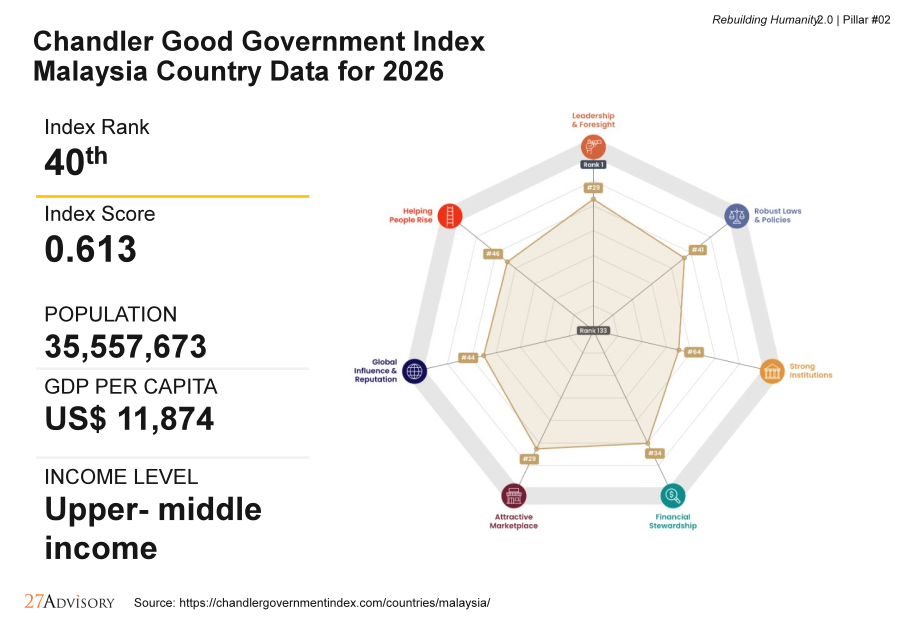
A snapshot of Malaysia’s performance across the seven pillars and 35 indicators of the 2026 Chandler Good Government Index, where it ranks 40th out of 133 governments.
This week’s Asia-Pacific release on the 2026 Chandler Good Government Index returned Malaysia’s standing to the headlines: 40th of 133 governments and second in ASEAN behind Singapore. The wider regional story was upbeat, with Asia-Pacific recording the strongest governance gains of any region and Singapore topping the table for the fourth consecutive year. On paper, that is a good headline for Malaysian public administration. But do not begin with the index. Begin with an applicant whose approval requires a local council, a state land office and several technical agencies to agree with each other, politely, eventually, on their own schedule. Each office may be functioning. Each officer may be doing the job exactly as written. And still, somehow, the file does not move. Everyone did their part. The file did not.
Set that motionless file alongside a thousand other frustrations over wages, rent, fuel and rising prices, and you get something close to the public mood that surfaced during the Johor and Negeri Sembilan campaigns this year. Nobody debates public administration on the campaign trail. But watch what people actually complain about while an election is underway, and you get an honest reading anyway. A scan of ordinary Malaysians’ posts online turned up the same grievances on loop: rising prices, wages that did not stretch far enough, fuel costs, unaffordable rent and taxes that felt increasingly burdensome. Not a scientific poll. Just the noise people make when someone is finally asking, even indirectly, how they’re doing. It was loud and consistent enough, across baseline, campaign and post-election windows alike, that it’s hard to wave off as campaign theatre alone.
Which leaves two uncomfortable questions sitting in the room. Growth is up. Unemployment is low. Real wages rose in the latest annual data. So why do so many households still sound exhausted? And if Malaysia’s government ranks this well, what exactly can the index tell us about its capacity to respond?
This is where the Chandler Good Government Index becomes relevant, but only to the second question. Produced annually by the Singapore-based Chandler Governance Group, it assesses 133 governments not on whether voters like them, but on whether their institutions can plan, legislate, spend, coordinate and deliver. It also measures outcomes people experience, including health and safety. By those criteria, Malaysia’s placing is respectable. Which is exactly what makes the complaints interesting.
The dashboard, and what it doesn’t settle
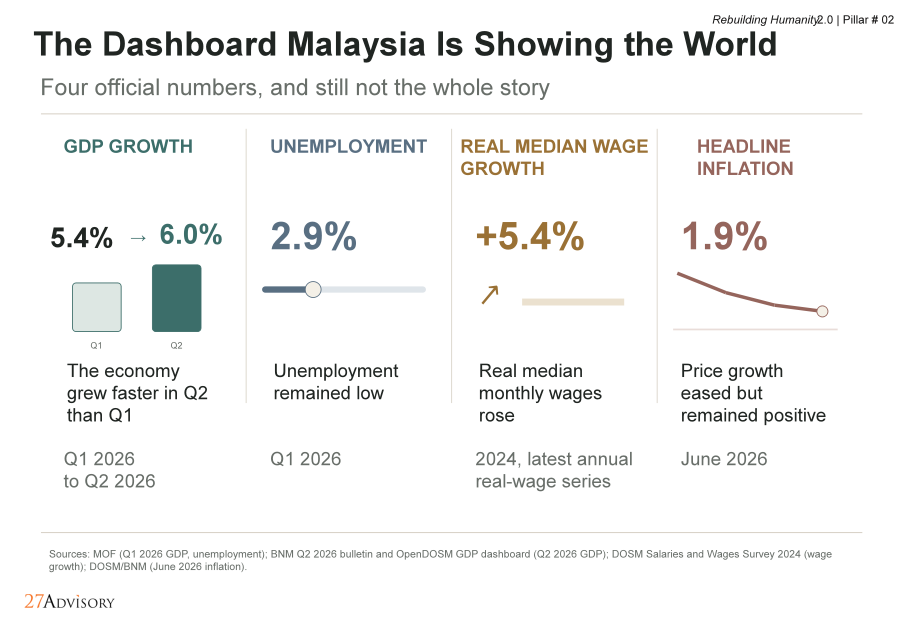
The headline numbers back that respectability up. The economy grew 5.4% in the first quarter of 2026 and accelerated to 6.0% in the second. Unemployment stood at 2.9% in Q1. Real median monthly salaries and wages among Malaysian citizens rose 5.4% in 2024. Headline inflation eased to 1.9% in June 2026.
None of those headline figures erases the pressure already built into household budgets. Housing and utilities, food and restaurants, and transport accounted for 67.2% of household spending in 2024, making even modest price increases highly visible in household budgets. Oppotus, which sampled selected Peninsular cities rather than the whole country, recorded confidence falling from 135 to 123 between Q1 and Q2 2026, with major-purchase intentions dropping further, from 121 to 103. A separate cross-country survey by Ipsos found Malaysians among the more confident populations globally in March. Confidence depends on who you ask. The honest conclusion is narrower: strong growth has not translated into uniformly stronger confidence for every household.
How can both be true at once? GDP tells us that the economy grew; it does not tell us how evenly those gains translated into household incomes. Even the good news has a footnote: real median wages rose 5.4% in 2024, but over the five years from 2019 to 2024, their compound annual growth averaged just 0.9%, compared with 3.3% in 2010–2019. Bank Negara Malaysia also found that, in the post-pandemic period, private-sector wage growth lagged both overall and food-and-beverage inflation. Lower inflation only slows the climb. It does not bring prices back down the mountain. For indebted households, debt servicing further reduces disposable income; Malaysia’s household debt stood at 84.8% of GDP at the end of 2025. A good year on paper can therefore arrive already spoken for. Chandler does not explain that squeeze. What it can assess is whether government institutions can coordinate and implement a coherent response once the problem is recognised.
What Chandler actually says
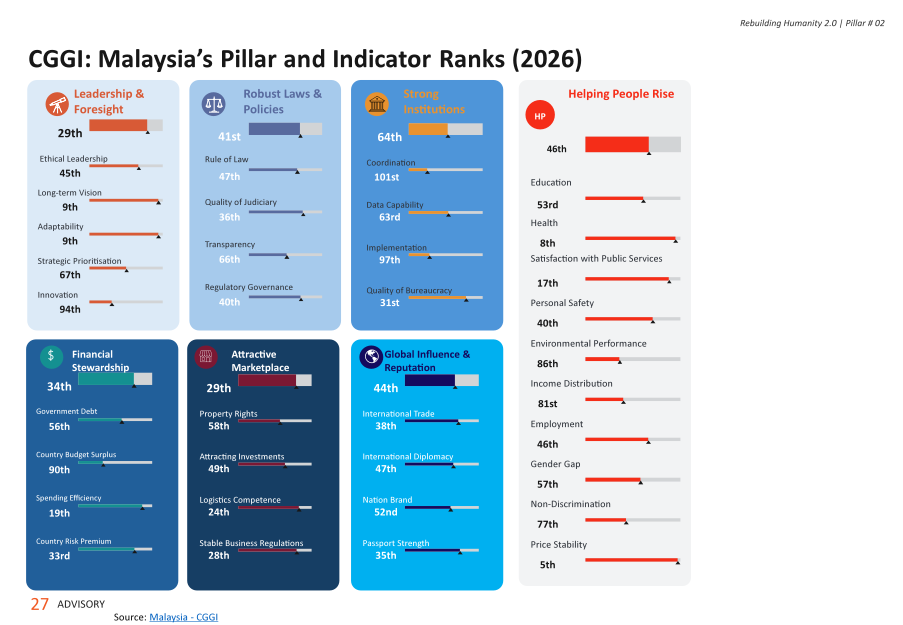
Two pillars are genuinely strong. Leadership and Foresight and Attractive Marketplace both rank 29th in the world. Financial Stewardship comes in at 34th, ahead of Malaysia’s overall ranking and particularly notable because it remains the weakest-performing pillar globally.
But even Malaysia’s apparent strength is uneven. Break Leadership and Foresight open and the pillar-level rank conceals the variation: Malaysia ranks 9th in the world for Long-term Vision and 9th for Adaptability, but 67th for Strategic Prioritisation and 94th for Innovation. We can apparently see the horizon just fine. Agreeing on what to do on Monday, and finding a new way to do it, remain more troublesome.
Strong Institutions is where the story turns hardest. Malaysia ranks 64th here, with Coordination at 101st and Implementation at 97th. Robust Laws and Policies sits at 41st. Helping People Rise, the index’s most outcome-oriented pillar, sits at 46th.
The easy conclusion would be that Malaysia performs best in the rooms where plans are written and worst at the counters where they are supposed to work. Easy, and not quite true. Chandler also ranks Malaysia 8th in the world for Health, 17th for Satisfaction with Public Services, and 5th for Price Stability, categories that sit much closer to daily life than “coordination” ever gets.
One caveat remains despite the precision of those ranks. Chandler does not publish the reference year for every underlying sub-indicator, so it would be unsafe to assign either the blame or the credit to any single administration.
Taken together, the honest read is messier: capability exists in patches, and it does not always survive the journey from the cabinet room to the person holding the queue number.
One ranking is not a verdict
The others show slightly different faces. The Blavatnik Index of Public Administration, measuring the civil service rather than the political system, puts Malaysia at 41st of 120 in its 2024 edition, an almost identical position, reached through an almost entirely different method. The World Justice Project’s Rule of Law Index is less flattering: 56th of 143 in 2025, weaker on rule of law than Malaysia looks on administrative capability. Put the three together and a government can be a competent administrator, a middling rule-of-law performer and an uneven strategist, all at once. No single ranking hands down the final grade. Each is sitting a different exam.
What would actually move the number
None of this needs a new blueprint; Malaysia already has enough of those to shade a car park.
What might move the number is duller than a blueprint: ownership, monitoring and publishing results that are not flattering. Australia’s APS Reform programme assigns project-management leadership for its 59 initiatives across nine agencies, while all agencies share responsibility for implementing the resulting changes. Its 2025 annual progress report stated that 54 initiatives were either complete or in delivery. That is evidence of implementation, although an official progress count is not proof that the reform programme caused every reported improvement. South Korea subjects digital-government investments to central oversight, performance monitoring and ex-post evaluation, examining alignment, costs, efficiency and outcomes rather than approving projects and hoping for the best. In the OECD’s 2023 Digital Government Index, Korea scored 83% for maturity in managing these investments, compared with an OECD average of 51%.
Malaysia doesn’t need to import either system wholesale; federal-state boundaries, procurement rules and data privacy make a straight copy unwise. What transfers is the discipline they demonstrate: identify a lead and the agencies that share delivery responsibility, report progress publicly, and evaluate after the fact instead of only announcing beforehand. Coordination and Implementation will not improve because someone writes a better five-year plan. They improve when someone is accountable for whether the plan happened.
External shocks, energy prices, freight costs and imported inflation can deepen household pressure. But geopolitics cannot chair an inter-agency meeting, reconcile overlapping mandates or tell an applicant who owns the next step.
For that applicant, the distinction between several functioning offices and one motionless application is largely academic. Growth is not fake, and neither is the ranking. But a government cannot expect a national statistic to feel like personal relief when an ordinary encounter with the state still ends with “under process.” The real test was never whether a plan was announced or a rank ticked up a place. It is whether competent government becomes visible in an ordinary week, at the counter and on the status screen, not only on the dashboard.
This article is part of 27Advisory’s Rebuilding Humanity 2.0, a nine-pillar knowledge framework for understanding the major structural changes shaping Malaysia’s future. The issues discussed are directly related to Pillar #02: Radical Fiscal & Governance Reset, which focuses on rebuilding fiscal discipline, distributional foundations and institutional accountability across the Federal and state governments. To explore 27Advisory’s sector research and advisory services, visit our Rebuilding Humanity 2.0 page.