

Why Malaysia’s food-security risk begins upstream, long before the supermarket shelf
Malaysia’s food-security risk does not begin at the supermarket shelf. It begins much earlier, at the point where farmers decide whether they can still afford to apply enough fertiliser for the next planting season.
That is the real lesson from the recent disruption in global shipping lanes. The issue is not only whether vessels are delayed or whether prices rise for a few months. The deeper issue is that Malaysia’s food system remains exposed to one of its most important upstream inputs.
Fertiliser is not just another farm supply. It is the input that shapes yields, planting decisions, and farm margins across the food system. When its cost rises sharply or supply becomes uncertain, the effects do not appear immediately on retail shelves. They appear first in farm-level decisions, and only later in supply, prices, and fiscal pressure.
The recent disruption did not create this vulnerability. It revealed it.
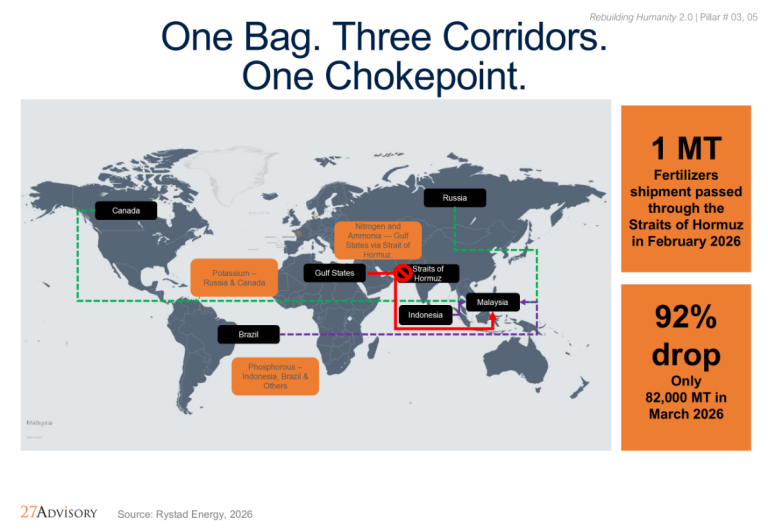
A bag of fertiliser may look like a single product at the farm gate. In reality, it brings together three different nutrient chains with three different risk profiles.
Nitrogen-based fertilisers depend heavily on natural gas and are linked to producers whose trade routes are vulnerable to disruption in the Gulf. One of the main fertilisers in this category is urea, which Malaysia does produce domestically. That gives the country some cushion, but not enough to remove price pressure entirely.
Phosphatic fertilisers are a different story. Malaysia remains heavily dependent on imports for phosphate-related inputs, and these sit within a wider global cost system shaped by international supply conditions.
Potassic fertilisers are exposed to yet another corridor, with heavy dependence on foreign suppliers such as Russia and Canada.
This means Malaysia’s fertiliser risk is not concentrated in one country alone. It is spread across multiple global supply corridors. When one corridor tightens, prices move. When several are under pressure at the same time, the impact becomes much harder to absorb.
This is why fertiliser should be seen not only as an agricultural issue, but as a supply-security issue.
The pressure has been building for years
The current strain did not appear overnight.
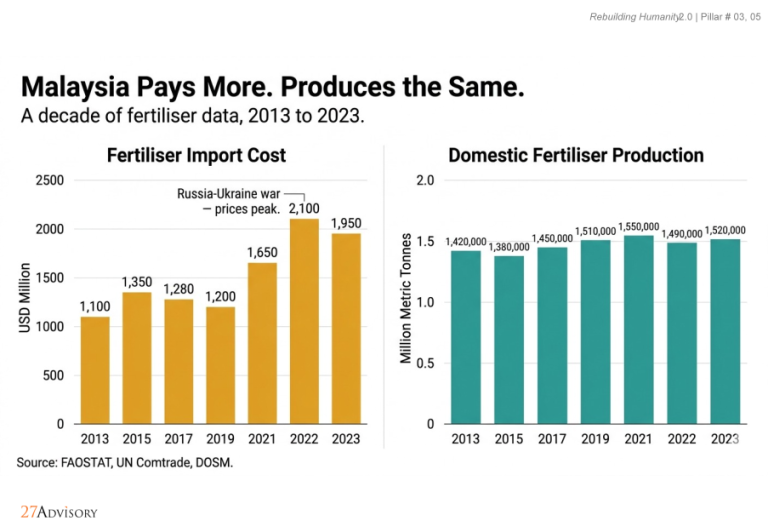
Over the past decade, Malaysia’s fertiliser import bill has risen sharply, even when import volumes did not always move in the same direction. That matters because it shows the system is exposed not only to how much fertiliser the country imports, but to the price at which global markets are willing to supply it.
In other words, this is not simply a volume problem. It is a price-exposure problem.
Malaysia’s domestic production has remained broadly limited relative to the wider needs of the system. That means higher global prices flow through to Malaysian agriculture even when local demand does not suddenly surge.
The shock does not travel evenly across crops
Fertiliser shocks do not affect all crops at the same speed.
Vegetables feel the impact first. Their crop cycles are short, often between 30 and 90 days. When farmers reduce fertiliser use, delay planting, or switch to lower-cost strategies, the effect can reach wholesale markets within weeks. For consumers, this may first appear as tighter supply and higher prices for leafy greens, chillies, tomatoes, and similar produce.
Paddy moves more slowly, but carries greater strategic weight. Rice remains central to Malaysia’s food-security agenda, yet the country is still below its own self-sufficiency targets. Fertiliser subsidies help soften the direct cost burden on farmers, but they do not remove the problem. When fertiliser prices rise sharply, the pressure shifts into the fiscal system. The cost does not disappear. It is redistributed.
Paddy also provides a useful example of cost structure. In many rice cultivation budgets, fertiliser represents around 15 to 25 percent of total production cost. That makes it one of the largest variable cost components in the system.
Vegetable farming shows the margin problem in a different way. For crops such as chilli, fertiliser cost pressure cannot always be passed on neatly to the market. Farmers respond by applying less, planting less, or accepting lower margins. This affects supply before it becomes visible in official consumer price data.
Oil palm feels the effect later, but at much larger scale. The sector accounts for roughly 80 to 85 percent of Malaysia’s total fertiliser use. Under normal conditions, fertiliser represents about 24 percent of production cost in oil palm. During major price spikes, that share can rise to 40 to 50 percent. The yield effect may only appear 12 to 18 months later, but by then the original input decision has already shaped output.
Together, these examples answer an important question: fertiliser costs matter not only in aggregate, but differently across crops depending on cycle length, strategic importance, and production economics.
What the consumer sees comes later
Consumers do not usually feel fertiliser shocks immediately.
The first signs appear upstream: smaller orders, delayed procurement, lower application rates, thinner farm margins, and reduced planting intensity. Retail prices and shelf-level shortages come later.
This matters because official inflation data can look calm even while the system is already under pressure. By the time the consumer notices, the farm-level decisions have already been made.
That is why fertiliser should be treated as an early-warning indicator in food security planning, not as a secondary input issue.
Malaysia protects two reserves, but not the third
Malaysia already applies strategic logic to some essential systems.
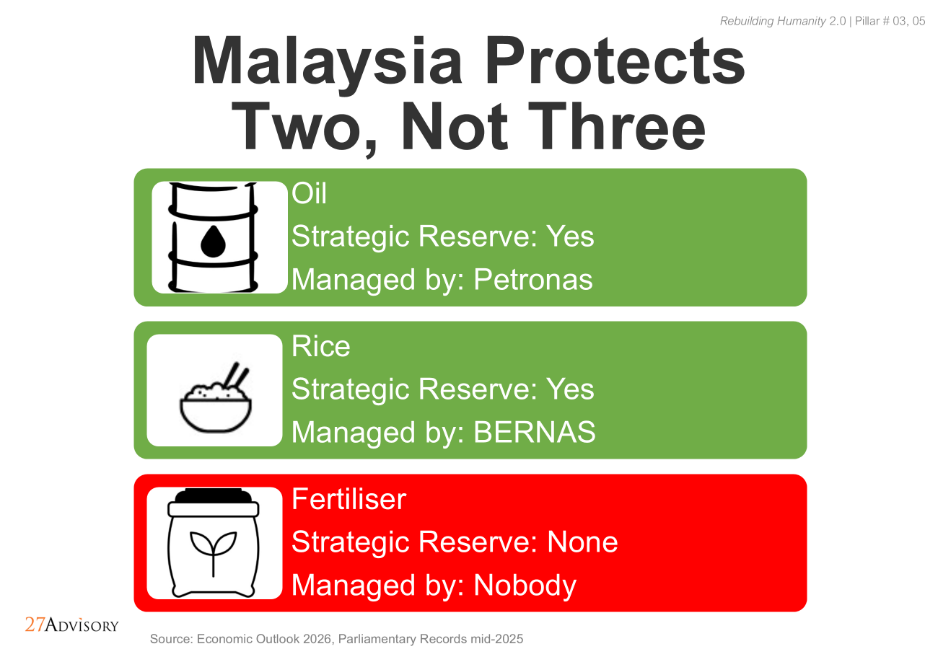
Petroleum is protected through formal reserve and security arrangements. Rice is supported through buffer-stock mechanisms and dedicated management structures.
Fertiliser has no equivalent.
There is no formal, government-managed national fertiliser strategic reserve with clear visibility over stock depth across the system. Inventories are spread across private estates, distributors, and different commercial actors. That leaves a major gap in preparedness.
This gap matters because fertiliser is the input that makes both rice and every other crop possible. A food-security architecture that protects downstream output while leaving upstream nutrients exposed is protecting only the visible half of the system.
What Other Countries Have Already Done
Other countries have already moved upstream. China and India maintain state-backed fertiliser reserves that can be deployed during planting seasons when prices spike. Brazil, despite importing the majority of its fertiliser, has shifted toward long-term supply agreements and domestic capacity development following recent disruptions. The common logic is not self-sufficiency. It is preparedness. Input security is treated as part of food security, not separate from it.
What follows from the evidence
Three priorities follow from the evidence.
First, Malaysia needs better visibility and buffering at the input level. A strategic fertiliser reserve, or at minimum a more coordinated stock-monitoring mechanism, would strengthen resilience before the next disruption arrives.
Second, Malaysia needs more diversified sourcing. This does not mean full self-sufficiency. It means reducing dependence on any one corridor or supply cluster. The goal is optionality, not isolation.
Third, Malaysia should accelerate practical alternatives where agronomically viable. This includes biomass-based and organic fertiliser pathways. Malaysia already has a strong base of underused agricultural biomass, especially from oil palm, rice, livestock, and agro-industrial waste streams. The opportunity is not only environmental. It is also strategic. Every viable substitute reduces exposure at the margin.
The real issue is not the latest disruption
The latest shipping disruption will eventually ease. Prices will stabilise at some new level. Trade routes will adjust.
But the structural issue will remain.
Malaysia’s food-security planning still focuses mainly on downstream outcomes such as rice targets, imports, retail prices, and buffer stocks. Those tools matter, but they do not fully protect the system if one of the most important upstream inputs remains exposed.
That is the bigger lesson here.
The Strait of Hormuz did not create Malaysia’s fertiliser vulnerability. It exposed the cost of managing food security downstream while leaving the productive base upstream only partially protected.
The next disruption will test the same weakness unless the architecture changes before it arrives.
This article is part of the Rebuilding Humanity 2.0 framework by 27 Advisory, which is built on nine key pillars to understand the most critical structural shifts shaping Malaysia. The themes explored in this article are directly linked to Pillar #03: Food Resilience & Agro-tech Leap and Pillar #05: Infrastructure, Water & Climate Resilience. Together, these pillars examine how Malaysia can strengthen food system resilience while building the physical and institutional foundations needed to withstand external shocks and long-term climate pressures. To learn more about 27 Advisory’s sector research and advisory work, visit our website CLICK HERE