

What changes when a brand from China enters the market?
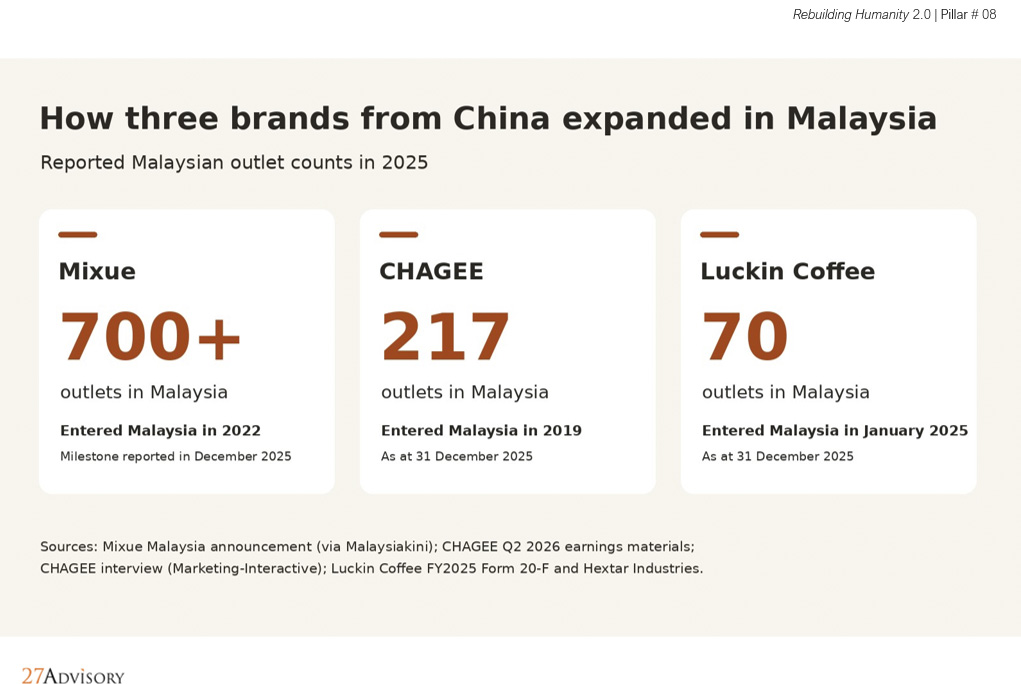
In January 2025, Luckin Coffee opened its first two Malaysian outlets, at Sunway Pyramid and Menara EcoWorld. Its local partner, Hextar Industries, made its name in fertiliser. Hextar’s subsidiary, Global Aroma, secured exclusive rights to develop and operate Luckin outlets in Malaysia for 10 years, with the right to request two successive five-year renewals. In December 2025, Hextar announced a proposed RM120 million sale of three fertiliser businesses and earmarked RM100 million of the expected proceeds for expansion of its food and beverage retail business.
An independent café now has a neighbour that takes orders through an app and has the backing of a listed company. When the launch offers end, what will make customers choose the independent café again?
A Malaysian student interviewed by CNA at a CHAGEE outlet in Kuala Lumpur offered one answer. She said the drinks were not the cheapest, but she liked the taste, the quality and the ambience.
The same pattern is reaching other trades. China-based car-care chain Tuhu has grown to more than 13 Malaysian outlets in three years. Its app lets drivers compare prices and book online. “We have no good answer right now,” said Clement Lim of Malaysian tyre firm Lim Tayar. In the same report, Malaysian Hairdressing Association president Ann Wang said salons operated by businesses from China work very long hours and price well below the going rate.
CHAGEE and Magma formed a joint venture in 2025 to expand the chain in Malaysia. CHAGEE holds 60 per cent and Magma Chain Management holds 40 per cent. The venture aims to open up to 300 directly managed outlets, subject to market conditions. Deals such as this give a Malaysian partner a stake in the expansion. The next question is how far the opportunity extends to other Malaysian businesses, from packaging suppliers to maintenance contractors.
How local brands won in China, and what Malaysian SMEs can learn
IMD researchers found that local brands won over shoppers in China by improving quality, developing products that reflected local tastes and giving customers more ways to judge quality for themselves. For Southeast Asian food businesses, Euromonitor’s Nathanael Lim offers a practical starting point: identify what customers value that rivals would struggle to copy, then adapt the product to local tastes.
Lesson one: decide what your customers would pay for or come back for.
The IMD authors point to CHAGEE’s Ming porcelain-inspired interiors and tea rituals, a premium experience that feels culturally its own. Luckin lets customers trace the origin of their coffee beans through a QR code, which the IMD authors describe as verification, not storytelling. Luckin also buys directly from Yunnan coffee farms and CHAGEE owns tea plantations in Guizhou, which gives both brands more control over sourcing. Lim adds that Southeast Asian consumers will pay more for health and quality benefits they can see.
In Malaysia, the lesson could take simple forms. For example, a kopitiam could name the estate and roaster behind its beans on the cup or the wall. A workshop could copy the one thing Clement Lim admires in Tuhu: simple booking. That could be a WhatsApp booking line with a fixed written quote before any work starts. Neither idea needs a chain’s budget. The kopitiam shows customers where its coffee comes from, and the workshop makes it easier to book and know the price upfront.
Lesson two: use data to innovate fast, while protecting your margin.
Luckin launched 119 new products in 2024. It used real-time sales and social media data to decide which to scale and which to drop. The IMD authors stress that firms in China can test in limited areas at low cost and withdraw quickly. That is a lesson about method, not money. An independent operator cannot fund years of losses the way a listed partner can. So, the test should be on the menu or the service, not on the price. One new item a month, sold for a fixed four weeks, is a realistic start. The owner tracks two things. Do customers order it again? Does it earn enough margin to stay on the menu?
What can the government learn from other countries?
Malaysian SME leaders are already asking for stronger rules. William Ng, president of the SME Association of Malaysia, told CNA that stricter requirements for local hiring and sourcing could help Malaysian firms benefit. Indonesia’s franchise rules show how one of those ideas has changed over time.
Indonesia’s 2012 franchise rules required at least 80 per cent local sourcing for raw materials, business equipment and merchandise, subject to exemptions. The 2019 rules removed the quota. Under the 2024 framework, franchise businesses must prioritise domestic goods and services that meet the franchisor’s quality standards. That leaves a practical question for Malaysia. What would help a local supplier meet those standards and win the order?
Phar Kim Beng of the International Islamic University Malaysia and Vic Li of the University of Sheffield make three proposals.
- Fair enforcement. Competition law, environmental rules, employment protections and tax obligations should apply equally to incoming firms.
- Make local sourcing and partnerships part of industrial policy. Encourage incoming SMEs from China to buy from Malaysian firms, help those suppliers improve, train local workers and form joint ventures.
- Build local capability faster. Malaysian SMEs should automate, digitalise, adopt AI and expand into ASEAN markets.
The Czech Republic offers one answer to the supplier question. CzechInvest matched local firms with multinational buyers and helped suppliers improve their products and processes. In a survey reported by the World Bank, 15 of 42 respondents said they had won new business worth more than US$46 million between 2000 and 2003 and attributed it to the programme.
Costa Rica shows what can follow a first contract. Economists Alonso Alfaro-Ureña, Isabela Manelici and José Pablo Vásquez estimated that four years after local firms began supplying their first multinational customer, they employed 26 per cent more workers and had total factor productivity 4 to 9 per cent higher. The study covered suppliers in manufacturing and services.
In Malaysia, that first contract could go to a bakery, a packaging supplier or a cleaning contractor. A simple way to see whether supplier development is working would be to track how many Malaysian SMEs win a first contract with an incoming chain each year, and how many receive a repeat order within 12 months. A first contract shows access. A repeat order shows whether the relationship continues.
Who benefits from Malaysia–China trade, and where can Malaysian SMEs gain more?
So far, the story has run in one direction: firms from China coming into Malaysia. But the door opens both ways. A deeper relationship with China should also mean more Malaysian SMEs reaching customers in China. The trade figures show the scale of that relationship. The bird’s nest trade shows what it takes for a Malaysian producer to reach a buyer in China.
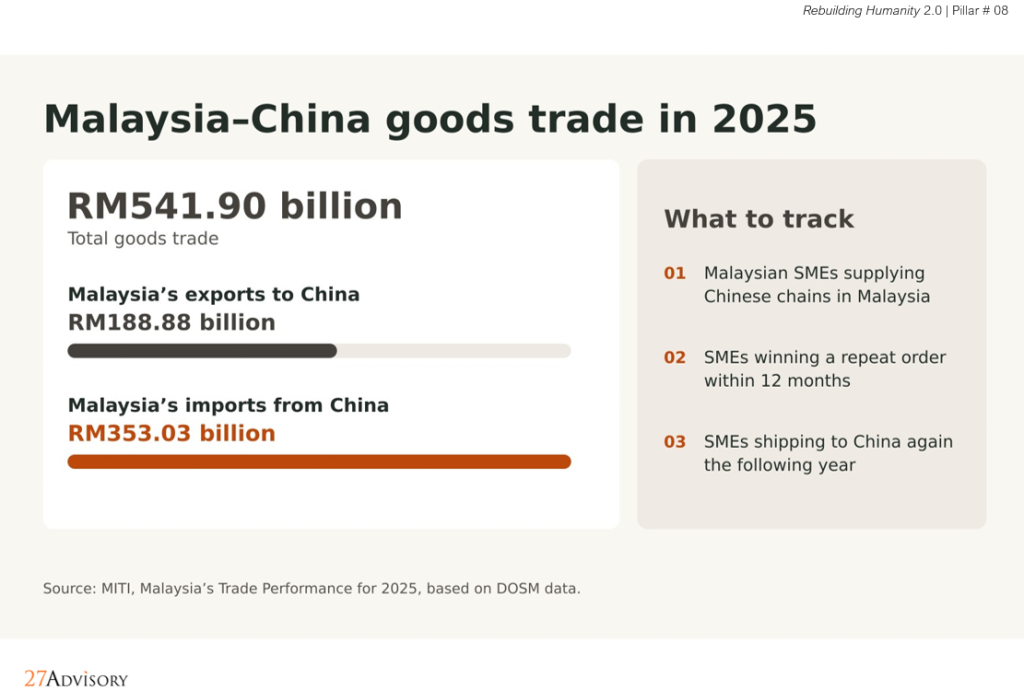
The headline numbers are large. In 2025, Malaysia’s trade with China reached RM541.90 billion. That is 17.7 percent of Malaysia’s total trade of RM3.061 trillion. China was Malaysia’s largest trading partner for the 17th year in a row. Malaysia exported RM188.88 billion in goods to China and imported RM353.03 billion.
What Malaysia sells matters more than the total. Electrical and electronic products were among Malaysia’s major exports to China. A bilateral trade balance tells us how much value crosses the border in each direction. It does not tell us how many Malaysian firms reached customers in China, or how much value stayed in Malaysia.
Edible bird’s nest is a useful test case. There is demand in China, and the route to market depends on whether Malaysian producers can meet the entry requirements.
- Demand. China is the main market for Malaysian bird’s nest. Agriculture and Food Security Minister Mohamad Sabu said exports to China rose from 201 tonnes in 2023 to 484 tonnes in 2024.
- Who can export. For raw-cleaned bird’s nest, processing premises must be listed by Malaysia’s Ministry of Health and registered with China’s customs authority through the Department of Veterinary Services.
- Main entry requirement. Exports run under a government-to-government protocol on inspection, quarantine and hygiene. A new protocol signed in November 2025 replaced the 2012 and 2016 agreements.
The risk is just as clear. In December 2024, exports to China were suspended after a Newcastle disease outbreak in Malaysia. The industry said 15 tonnes of stock worth RM50 million could not be sold ahead of Chinese New Year. Durian shows the same pattern. Fresh durian could only go to China after a phytosanitary protocol was signed in June 2024, and the first shipment left that August.
Luckin reached Malaysian customers through a local partner. For a Malaysian bird’s nest producer, the route to buyers in China starts with a negotiated protocol and a registered processing plant. This raises a practical question for officials. How many Malaysian SMEs are on each China export list, how many shipped this year, and how many shipped again the next year? That is the same first-contract and repeat-order test, applied to exports. If Malaysia wants a deeper commercial relationship with China to benefit its own firms, those are the numbers that will show it.
Competing without becoming spectators
The café owner in the mall cannot outspend her new neighbour and does not need to. What she can do is make her quality visible, test small and keep the customers who come back. That is the lesson China’s own brands teach.
Officials face a parallel choice. Open doors with no linkages would leave local SMEs, in Phar Kim Beng and Vic Li’s words, as spectators in their own economy. The middle path is harder but measurable. It means fair rules, real supplier development and protocols that open China’s doors to more Malaysian firms.
The test for both is the same. Did a Malaysian firm win a first customer it did not have before, and did that customer come back? Brands from China are here to stay. Whether their arrival makes Malaysian firms stronger depends on decisions made now, in kedai and in ministries alike.
This article is part of 27Advisory’s Rebuilding Humanity 2.0 framework, a nine-pillar knowledge architecture for navigating Malaysia’s most consequential structural transitions. The themes explored in this piece connect directly to Pillar #08: SME, Entrepreneurship and Regulatory Rewiring, which examines how Malaysian enterprises can grow, compete and be governed well in a changing economy. To explore 27Advisory’s sectoral research and advisory work, visit our Rebuilding Humanity 2.0 page.