
In Part 1, we tested a “what if”: make the first RM100,000 of chargeable income tax-free for every taxpayer, lower the rates above it to a top rate of 22%, bring back GST in place of the Sales and Service Tax (SST), and give cash help to lower-income households. It is a working scenario prepared for discussion, not a government proposal.

We followed three illustrative households, using the income tax rules Budget 2027 proposes for 2027. Amir, a delivery rider, and Rashid and Aina, a two-income middle-income family, pay no income tax, so the cut would save them nothing. Farah, an engineer earning RM10,000 a month, would save about RM9,300 a year. Someone with RM1 million of chargeable income would save about RM75,600. We also found that GST would first have to replace SST’s RM73.3 billion before it could pay for anything else.
Part 2 asks the rest of the question. What have other countries learned? What would it take to make a swap like this work in practice? Would the public accept it? It ends with three questions readers can use to judge the idea for themselves.
What other countries show
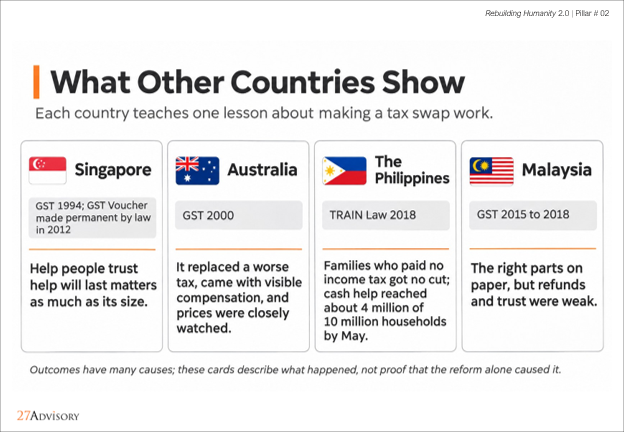
We looked at three countries, plus Malaysia’s own past. Each one teaches something different. No comparison is perfect. Prices, recessions and elections have many causes, so we describe what happened alongside each reform without claiming the reform alone caused it.
Singapore: help that people can trust. Singapore introduced GST in 1994 and has raised it over time, most recently to 9% in 2024. In 2012, it made its GST Voucher permanent by law and gave it its own fund. The reason, in the government’s words, was to give lower-income Singaporeans “greater certainty of payments”, instead of depending on each year’s budget. Today GST brings in about 16% of Singapore’s operating revenue. The lesson is simple: help that people believe will last is worth more than help that is bigger but uncertain. Singapore’s strong reserves and careful administration make this easier there than in most countries.
Australia: a swap that replaced something worse. Australia brought in a 10% GST in 2000. It replaced ten older taxes, including the costly wholesale sales tax. It came with income tax cuts, a higher tax-free threshold and higher pensions. The Treasury later found that every type of family gained in real income. Prices did rise. GST and the related changes added about 2.5 percentage points to inflation in 2000-01. But the competition regulator watched prices closely. It investigated about 6,200 GST-related cases and mailed a price guide to every household. People’s expectations of inflation fell from 8.2% in May 2000 to 4.6% by mid-July, just after the launch.
The lesson: a swap works best when it removes a worse tax, shows people their compensation clearly, and stops businesses from using it as an excuse to raise prices.
The Philippines: when the tax cut goes to someone else. In 2018, the TRAIN Law cut income tax for most taxpayers, while raising taxes on fuel and sugary drinks and widening VAT. Poorer families who paid no income tax got nothing from the cuts, but they faced higher prices. Cash help was meant to protect them. But by May 2018 it had reached only about 4 million of roughly 10 million target households. Inflation averaged 5.2% that year, a ten-year high, also driven by rice shortages and global oil prices. A study listed by the Philippine Institute for Development Studies projected that more Filipinos could fall into poverty. It shows the risk for households like Amir’s and Rashid and Aina’s if help does not reach them in time.
Malaysia: the right parts, but not enough trust. Malaysia’s GST started at 6% in April 2015. It came with income tax cuts of 1 to 3 percentage points, a lower top rate and continued BR1M cash aid. The government said about 300,000 people would stop paying income tax altogether. On paper, it looked like the swaps that worked elsewhere. Yet GST became a central issue in the 2018 general election. The winning coalition had promised to abolish it. GST was set to zero on 1 June 2018 and replaced by SST that September. Many things shaped that election. But the GST years left clear lessons about where the system was weak, especially refunds and trust.
Making it work in practice
A tax swap is announced in a budget speech. But it is lived in invoices, refund queues and bank transfers. Four practical issues decide whether it works.
Refunds businesses can rely on. GST is only fair to businesses if they get their refunds on time. Here Malaysia’s own record is the clearest warning. In 2018, the new Finance Minister reported about RM19.4 billion in GST refund claims still owed to 121,429 businesses and individuals. The fund meant for refunds held only about RM148.6 million. Parliament’s Public Accounts Committee later looked into it. It recorded the Attorney General’s view that moving GST money straight into the government’s general account broke the GST Act’s promise of refunds. The lesson is about the system, not about blame. Refunds need a fund protected by law, clear processing times and independent checks, so they never depend on how much cash the government has that month.
Businesses are not all the same. GST affects them in different ways:
- Exporters charge no GST on what they sell overseas, but they pay it on what they buy. So, the government often owes them money. If refunds are slow, their cash gets stuck.
- Companies investing in growth also build up large refund claims while they expand.
- Very small businesses below the registration threshold stay outside GST. They avoid the paperwork, but they also cannot claim back the tax on what they buy.
- Shops and service providers must change prices, systems and training. These costs weigh more on a small shop than on a big chain.
Australia found that GST added paperwork, but that the cash-flow benefits of claiming back tax mostly made up for it. After 16 months, 90% of business leaders surveyed were comfortable with the system. Reliable refunds are an important part of making such a system work.
Small businesses would also not face GST alone. Budget 2027 already cuts SME tax slightly, from 15% to 14% on the first RM150,000 of profit, and from 17% to 16% on the next RM450,000. But the World Bank warns of a “tax cliff”. Once a company grows too big to count as an SME, it loses its SME rates at once and pays 24% on all its profit. Some owners may choose to stay small to avoid it. Any tax reform for business should smooth that cliff, not just change the rates.
Help that reaches people. Malaysia already has a large cash aid system, before any compensation for a GST. Budget 2027 gives RM16 billion to STR and SARA, reaching about 9 million people, plus two RM100 SARA credits for up to 13 million adults. But reaching many is not the same as reaching everyone. When the national PADU database opened in 2024, 17.65 million accounts were registered, but only some people updated their details. A family missing from the data would face higher prices with no help. And even families on the list can be left waiting. In the Philippines in 2018, cash help reached only about 4 million of roughly 10 million target households by May, while prices were already rising. A good scheme needs an easy way to apply, a clear way to appeal, and published figures on who is reached and who is missed.
Help that lasts. A tax is permanent. Compensation set in one year’s budget can change in the next. Singapore’s answer was to put its GST Voucher into law, with its own fund. People will judge a swap partly on whether they believe the help will last.
Will people accept it?
A reform can be well designed and still fail if people do not accept it. The evidence points to four things that shape acceptance.
Understanding. In April 2014, a year before GST began, the Merdeka Center asked 1,009 voters in Peninsular Malaysia what they thought. Sixty-two per cent opposed GST, and 53% said they did not understand how it would work. People resist what they cannot follow. A swap is even harder to follow, because the gain and the cost arrive in different ways. Farah sees her gain on her pay slip once a month. Amir and the M40 family could face higher prices on some of the goods and services they buy.
Trust in how the money is used. When that survey came out, the Merdeka Center’s head said that regular reports of waste make people “wonder if their tax money will be prudently spent”. Other analysts agreed, though some said worry about the cost of living mattered more. Today, Malaysia scores 51 out of 100 in the Open Budget Survey 2025, below the 61 points seen as enough for informed public debate. Its score for public participation is 20. The think tank IDEAS has called for clearer reporting on spending outside the main budget, on borrowing and on what spending actually achieves. It is easier to ask people to pay a broad tax when they can see where it goes.
Trust in the help. Researcher Lee Hwok Aun of the ISEAS Yusof Ishak Institute studied Malaysia’s fuel subsidy reform. He found that senior officials strongly believed cash help could never fully make up for public anger over higher prices. Whether or not that is true, it shapes how governments act. It suggests help works better when it is automatic, lasting and visible before prices change, not promised afterwards.
Fairness. People judge a tax by who seems to gain from it. In this scenario, the largest ringgit savings go to the highest earners, while GST is paid by everyone who shops. Some people may see this as unfair. Others may judge it worthwhile if the revenue pays for services and help they value. The government has voiced related concerns. In June 2025, Prime Minister Anwar Ibrahim said many lower-income Malaysians are not yet able to absorb the cost of GST, even with exemptions [20]. In August 2026, he said he did not want a tax “imposed on the people comprehensively”, while staying open to improving SST.
So acceptance is not only about the tax. It is also about how well public money is spent. The OECD makes the same link. It points to better spending, alongside more revenue, as the way to pay for stronger safety nets and public services.
What would we need to know?
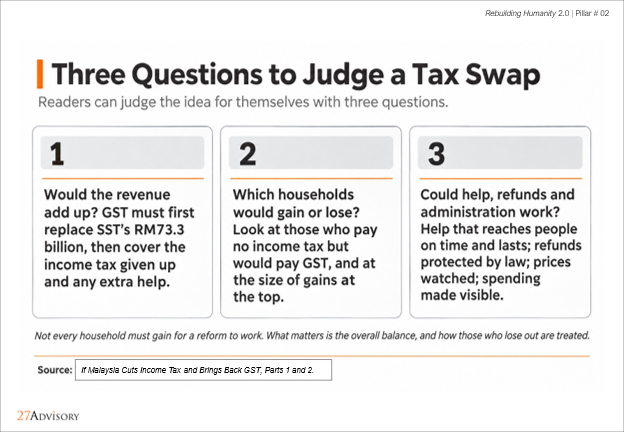
Readers can judge this scenario for themselves. Three questions decide whether a swap like this would serve Malaysia. None of them requires every household to gain. Most reforms have winners and losers. What matters is the overall balance, and how those who lose out are treated.
1. Would the revenue add up?
GST would need to replace SST’s RM73.3 billion, cover the income tax given up, and pay for any extra help, after refunds. A published estimate, with its rate, its exemptions and its assumptions, would show whether it does.
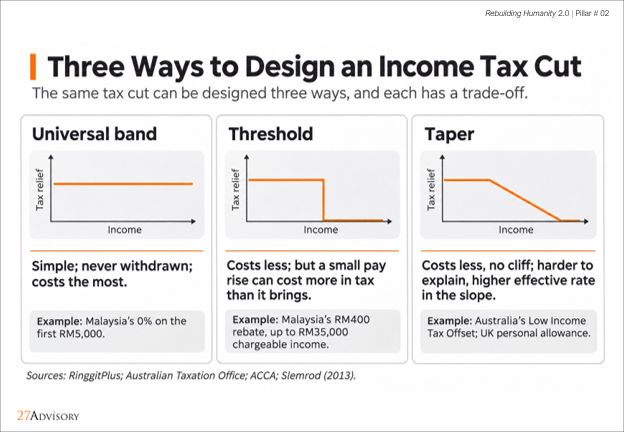
The design of the income tax cut changes that bill a great deal. Here are three common designs, with their trade-offs:
Table 1: Income Tax Cut Design
| Design | How it works | Strengths | Weaknesses | Where it is used |
| Universal tax-free band (this scenario) | Every taxpayer’s first slice of income is tax-free | Simple to understand. The benefit is never withdrawn as income rises | Greater revenue loss when the same relief is also extended to higher earners | Malaysia’s 0% rate on the first RM5,000. |
| Threshold | Relief only for people below an income line | Limits relief to lower- and middle-income taxpayer | Needs eligibility rules. A sudden cut-off can make a small pay rise cost more in tax than it brings in. Economist Joel Slemrod calls these cut-offs “notches”. | Malaysia’s RM400 rebate, which stops once chargeable income passes RM35,000. |
| Taper | Relief fades gradually as income rises | Gradually reduces relief as income rises, without a sudden cliff | Harder to explain. People in the fading range face a higher effective tax rate on each extra ringgit | Australia’s Low Income Tax Offset: up to A$700, gradually reduced as income rises. . The UK personal allowance: reduced by £1 for every £2 above £100,000, an effective 60% rate in that range. |
Note: Revenue costs depend on the amount of relief and who qualifies. Targeted designs forgo less revenue than universal relief when eligible taxpayers receive the same amount of relief.
There are also other ways to raise revenue, and the evidence differs on which to use, and when. The OECD recommends a broad consumption tax with targeted help, together with a broader personal income tax base: fewer deductions and exemptions, and more forms of capital income taxed. The World Bank’s lead economist for Malaysia, Apurva Sanghi, recommends lowering the income level where higher rates begin and limiting reliefs for high earners, without raising rates. IDEAS supports GST’s strongest features, but only as part of a wider reform. The government says a broad consumption tax should wait until incomes rise, and the Economy Minister puts wage growth first. These views differ mainly on timing and tools, not on the goal of a broader, steadier revenue base.
2. Which households would gain or lose?
Our three examples show that the answer depends on more than the income tax cut. A full answer would need two things that are not yet published in usable form: LHDN data on how many taxpayers sit at each income level, and household survey data on how much SST each group pays now and what a GST would change. Without them, no one can say precisely who would gain and who would lose. The examples point to where to look most closely: households that pay no income tax but would pay GST, especially lower middle-income families who may receive little cash help, and the size of the savings at the top.
3. Could help, refunds and administration work reliably?
The experience of Singapore, Australia, the Philippines and Malaysia’s own GST years suggests five practical tests. Does compensation reach households, including those missing from databases, and arrive in time?
Is it set in law, so that it lasts?
Are business refunds protected and paid on time?
Are prices monitored during the change?
And can people see how the revenue is used?
IDEAS, for example, argues that any consumption tax reform must come with better-targeted relief for lower-income households and small businesses, and clearer reporting on spending.
Who pays then?
Under the proposed rules for Year of Assessment 2027, Amir, Rashid and Aina would already owe no income tax. The cut would therefore leave their income tax bills unchanged. For Farah, the saving would feel like a pay rise.
But the bill does not disappear. Someone pays it: at the shop, on a pay slip, through a company’s accounts, or through borrowing that the next generation will help repay. A swap that looks attractive on paper has to show that its numbers add up, that its help reaches people, and that its systems work.
Whether this one would, readers can now weigh for themselves. The three questions above are the place to start.
This article is part of 27Advisory’s Rebuilding Humanity 2.0 framework, a nine-pillar knowledge architecture for navigating Malaysia’s most consequential structural transitions. The themes explored in this piece connect directly to Pillar #02: Radical Fiscal and Governance Reset. To explore 27Advisory’s sectoral research and advisory work, visit our Rebuilding Humanity 2.0 page.