
Ageing is not the problem
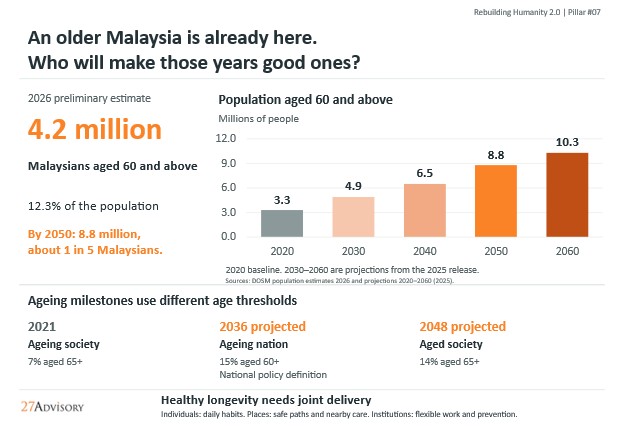
Malaysia is getting older. By 2050, about one in five Malaysians will be 60 or older.
This is usually told as a story of rising costs: more patients, more pensions, fewer workers. But that is only half the picture. Much of the illness that weighs on later life can be prevented or delayed. That changes the equation.
Healthy years are not only a social goal. They are an economic one. Every year of good health is a year in which a person can work, care for family, mentor, volunteer and spend. Every year lost to preventable illness is a cost carried by families, employers and the public purse.
So the real question is not whether Malaysia will age. It will. The question is whether those extra years will be healthy ones, and who will share in them.
The good news comes first
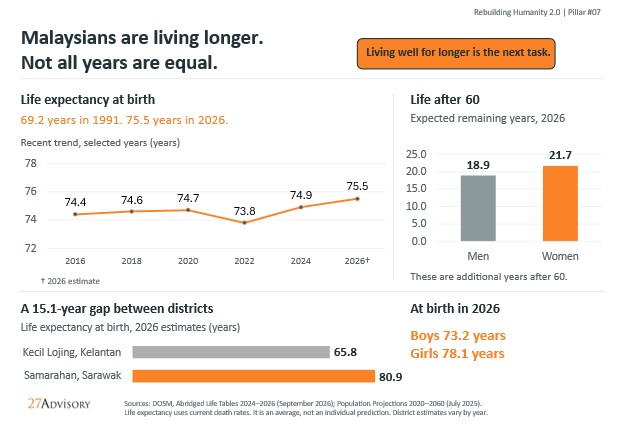
In 1991, life expectancy at birth in Malaysia was 69.2 years. DOSM’s estimate for 2026 is 75.5 years, with 78.1 for girls and 73.2 for boys, based on current death rates.
Part of that gain came from fewer people dying young. Vaccination, maternal care, rural clinics, clean water and schooling did their quiet work over decades. Far more Malaysians now survive childhood and working life to reach their sixties. Globally, life expectancy at birth rose from about 32 years in 1900 to 73 years in 2023, according to Our World in Data.
Malaysia’s improved survival is a national achievement, and it is worth saying plainly. Malaysia has made substantial progress in survival. The next task is to improve the health and opportunities available in those later years. Statista’s comparison of selected G20 countries shows how differently those gains have unfolded across countries.
Making the extra years count
The next challenge is harder. It is about the years after 60, and how good they are.
DOSM estimates that a Malaysian man who reaches 60 in 2026 can expect another 18.9 years of life, while a woman can expect another 21.7. These averages show why planning for later life matters. They do not tell us how healthy or independent those years will be. As Visual Capitalist’s US chart illustrates, remaining life expectancy depends on the age a person has already reached.
Quality matters alongside length. The World Health Organization distinguishes life expectancy from healthy life expectancy, which estimates years lived in full health after accounting for illness and injury. Living longer does not automatically mean gaining the same number of healthy years.
This is why experts separate lifespan from healthspan. Lifespan counts birthdays. Healthspan counts healthy years. The everyday question is whether you can still walk to the surau, carry a grandchild, manage your own money and choose how to spend your day. A longevity worth wanting is measured by the second.
An older Malaysia is already here
This is not a distant future. DOSM’s preliminary estimates put Malaysia’s population aged 60 and above at about 4.2 million in 2026, or 12.3% of the population. The median age has reached 31.7.
Under the National Elderly Policy’s definition, Malaysia is projected to become an ageing nation by 2036, when people aged 60 and above make up at least 15% of the population.
Longer lives are only half the story. Malaysians are also having fewer children. The fertility rate stood at 1.67 in 2024, below the level needed to replace the population. A growing share of older people and a smaller share of younger people will change how families, workplaces and public services work.
None of this needs to be a crisis. A joint statement on Budget 2026, endorsed by 17 Malaysian organizations working with and for older people, described ageing as a test of coordination.
The silver economy is an opportunity, if it is shared
Around the world, ageing is being reframed as a source of demand, work and new industries, not only a cost. This is often called the silver economy or the longevity economy.
Malaysia is moving in this direction. The National Ageing Blueprint 2025 to 2045 informs measures under the 13th Malaysia Plan and addresses ageing across employment, education, social protection, health and long-term care. The Malaysia Care Strategic Framework and Action Plan 2026 to 2030 is in place. In November, Kuala Lumpur hosts the Silver Economy Forum 2026 under the theme “Healthy Longevity for Economic Growth”.
The opportunity is real. But a useful question comes from Nitin Jaiswal, founder of AgeTech Leadership Labs: opportunity for whom? He draws a line between a longevity market and a longevity economy. A market grows simply because people live longer and buy more products and services. An economy asks whether the people living those years can take part in the value being created.
Jaiswal also contrasts what he calls Penthouse Longevity with Pavement Longevity. The penthouse is the private clinic and the advanced biomarker test. The pavement is where most people actually age: the district clinic, the bus stop, the family home. Even Simone Gibertoni, Group CEO of Switzerland’s Clinique La Prairie, warns that longevity medicine risks becoming “a concierge privilege of the few”.
For Malaysia, the test is whether these opportunities reach every district. DOSM’s 2026 estimates show life expectancy at birth of 80.9 years in Samarahan and 65.8 in Kecil Lojing, a gap of about 15 years. These differences show why national averages are not enough. A longevity economy should expand participation while addressing unequal access to health and support.
How we get there: three layers of responsibility
Good longevity is built at three levels. Each one depends on the others.
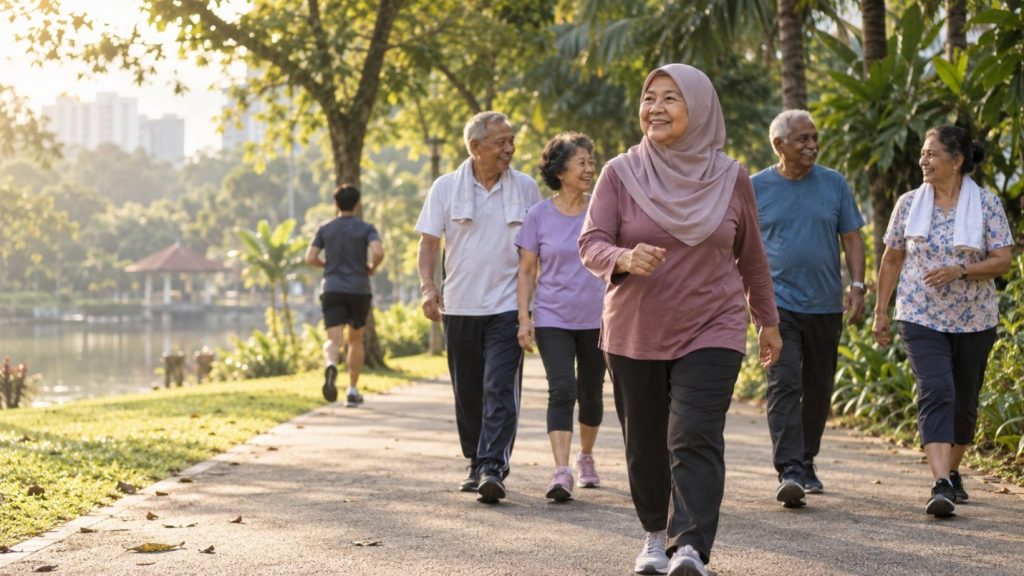
The first layer is what each of us can do. The strongest evidence is also the least glamorous. Regular movement, muscle strength, good sleep, not smoking, controlling blood pressure and blood sugar, appropriate screening and staying connected to other people. Gibertoni himself says the best-proven foundations of longevity medicine come in no capsule. These foundations belong in everyday life, but access to them is not equal.
For many Malaysians, faith and tradition give caring for the body a deeper meaning. The body is a gift held in trust, not simply something we own. Caring for it is not vanity. It is a responsibility to ourselves and to the people who depend on us, practised quietly every day.
Tun Dr Mahathir Mohamad, who turned 100 in 2025, is often held up as an example of active later life. His story brings the question closer to home: what helps people remain engaged as the years accumulate? Daily habits matter, but so do opportunities to participate, supportive surroundings and access to care. Those conditions should be within reach of ordinary Malaysians too.
The second layer is our surroundings and services. Telling someone to walk more means little if there is no safe path. Advice to check blood pressure means little if the nearest clinic is two hours away. Places that make healthy choices easy, with shaded walkways, reliable transport, accessible homes and nearby clinics, do much of the work for us.
The third layer is institutions. Employers can offer flexible roles, adjusted physical demands and ongoing training. Insurers can reward prevention without excluding people with existing conditions. The health system can shift further towards prevention, chronic disease management and rehabilitation. Government can measure success not only by total years lived, but by healthy years, district by district.
There is also a harder question: who owns healthy longevity? Health sits in one ministry. Walking paths, housing, transport, food and work sit in many others. When everyone shapes an outcome, it is easy for no one to own it. In 2025, the government said it may consider a national council on ageing to lead the silver economy under the National Ageing Blueprint. If it is set up, it will need real authority across ministries, not just a seat at the table.
Changes in daily activity do not have to take decades. Singapore’s National Steps Challenge gave adults free step trackers and small rewards. Its first four seasons reached about 1.3 million people, roughly a quarter of adults. A study of its third season linked it to about 1,400 more steps a day on average. Women aged 69 and above recorded about 2,300 more steps a day, among the largest increases. The findings suggest that well-designed programmes can encourage older people to be more active.
Longer lives, longer careers, more choices
Longer lives will also reshape work and learning. As Dr Ira Sobel notes, an upcoming EFMD conference asks what management education should look like for “100-year lives and 60-year careers.” If a working life lasts 60 years, learning cannot stop at 25.
Artificial intelligence may help here. Tools that draft, translate, explain and answer questions in plain language could make it easier for older workers to learn new skills and stay in roles they value. The evidence is still early, and access is uneven. But it is a door worth opening with care.
The goal should be choice, not obligation. A longer life should offer more ways to contribute, through paid work, mentoring, caregiving, volunteering or learning. It should not mean working longer simply because survival depends on it.
This article opens a series on Malaysia’s longevity future. The pieces that follow will ask how we stay well for longer, how older Malaysians can keep contributing on their own terms, how longer lives ripple through families and services, and how people and institutions can prepare.
Malaysia’s next task is to make those years healthy, purposeful and fairly shared. That takes preparation by individuals, families, businesses and government. Old age is not the risk. Unprepared old age is.
This article is part of 27Advisory’s Rebuilding Humanity 2.0 framework, a nine-pillar knowledge architecture for navigating Malaysia’s most consequential structural transitions. The themes explored in this piece connect directly to Pillar #07: Secondary Healthcare & Care Economy, which examines how Malaysia builds the human, institutional, and financial infrastructure required to serve an ageing population while transforming care into a productive economic sector. To explore 27Advisory’s sectoral research and advisory work, visit our Rebuilding Humanity 2.0 page.