
Budget 2027 shows that Malaysia’s fiscal reforms are holding under an energy shock. Keeping fuel protection credible will need recurring non-oil revenue, support that follows real need, and fewer unavoidable fuel costs in daily life.
Malaysia set aside about RM15 billion for fuel subsidies when it planned its 2026 budget. Then the conflict in West Asia sent energy prices sharply higher. The Ministry of Finance now estimates this year’s fuel subsidy bill at RM40 billion. Budget 2027 expects a similar amount next year.
The monthly figures show how quickly the pressure arrived. MOF puts the RON95 and diesel subsidy bill at about RM700 million in January and nearly RM5 billion in March. Even after prices eased, it projected roughly RM3.5 billion a month in June.
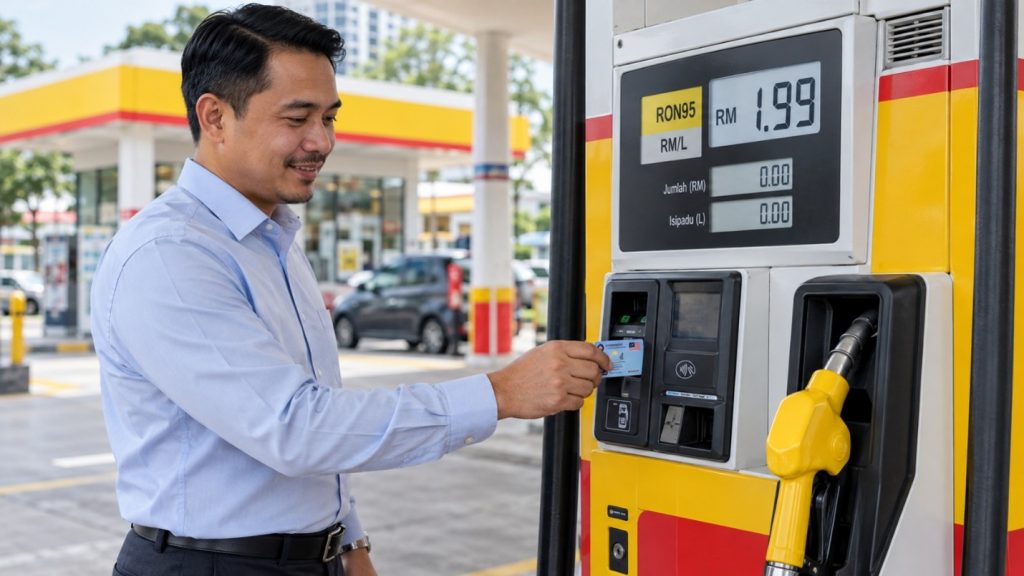
For households, that spending is real protection. Eligible Malaysians still pay RM1.99 for a litre of RON95. For the Treasury, it is a continuing obligation worth roughly one ringgit in every nine of federal revenue. The question after Budget 2027 is not whether Malaysia should protect people from expensive fuel. It is how to keep that protection affordable without weakening the schools, hospitals and infrastructure the same households depend on.
Fiscal progress has provided a cushion
The fiscal position has held up better than the size of the shock might suggest. The deficit was 3.7% of GDP in 2025. It is now estimated at 3.6% in 2026, against an original target of 3.5%, while the 2027 budget aims for 3.3%. That is progress under pressure.
That resilience did not appear by chance. Federal revenue for 2026 is now estimated at RM363.6 billion, 6% above the original budget estimate. The Fiscal Outlook credits earlier revenue reforms, the expanded Sales and Service Tax and stronger compliance through e-invoicing. The government also reprioritised spending to contain the impact of higher crude prices.
The redesign of subsidies has helped too. RON95 subsidies in the fourth quarter of 2025 were about RM1.8 billion, down from RM3 billion a year earlier. The ministry credits BUDI95, lower oil prices at the time and reduced leakage to non-citizens and smugglers. Diesel reform since 2024 has also produced savings that the ministry puts in the billions of ringgit each year. Part of the cushion came from oil itself. The expected PETRONAS dividend for 2026 was revised up from RM20 billion to RM27 billion. That is welcome. It is also a reminder that some of this year’s room was supplied by the same oil price that created the problem.
Why the bill can rise after reform
If targeting works, why did the bill still rise so much? The answer is simple arithmetic. A fuel subsidy bill is roughly the number of subsidised litres multiplied by the gap between the market price and the supported price.
Eligibility rules and monthly limits can restrain the number of litres the government subsidises. BUDI95 offers the supported price to Malaysian citizens with a valid driving licence, up to a monthly allowance. That allowance was cut temporarily from 300 to 200 litres in April and restored to 300 litres in September. In September, fewer than 1% of users reached the limit. BUDI95 is not an income test. It decides who qualifies and how much they can buy at the supported price.
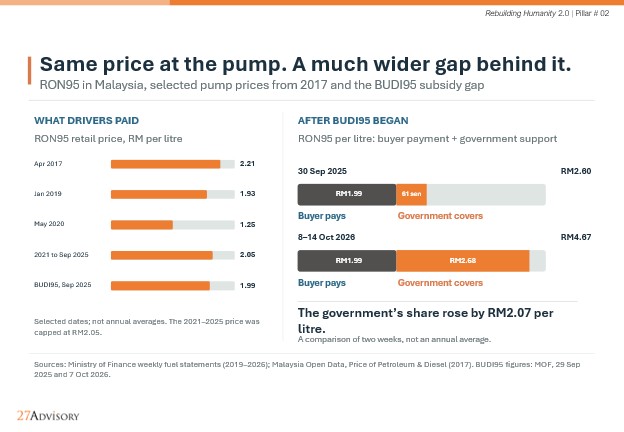
The market price, which determines one side of that gap, is set largely outside Malaysia. When BUDI95 began in September 2025, unsubsidised RON95 cost RM2.60, so the government covered 61 sen a litre. The week of 8 to 14 October offers a snapshot of the exposure. Unsubsidised RON95 was RM4.67 a litre, leaving RM2.68 for the government to cover when an eligible driver paid RM1.99. The corresponding BUDI Diesel gap was RM3.17.
The fuel at the pump is a refined product, not crude oil. MOF points to tight international supply of refined petroleum, even as crude flows from West Asia slowly recover. Refining conditions, the exchange rate and consumption all shape the bill. So a larger total does not mean targeting has failed. Targeting reduces how much Malaysia pays for each shock. The size of the shock is still decided by world markets.
What a bigger cake must deliver
If Malaysia chooses to hold the supported price steady through a global shock, it needs revenue that does not rise and fall with oil. A bigger cake matters only if it feeds those steadier streams.
Each part of a growing economy feeds a different tax. Better-paid jobs feed individual income tax, expected at RM51.8 billion in 2027. Healthier companies feed corporate income tax, the largest single source at RM106.6 billion. Household spending feeds the Sales and Service Tax (SST), projected at RM73.3 billion. Petroleum income tax, by contrast, is expected to stay flat at RM20.5 billion.
Malaysia has already seen how a broad non-oil base protects the budget. When oil prices collapsed in 2015, petroleum income tax fell 64.6% to RM9.5 billion. Oil’s share of federal revenue, 41.3% in 2009, was expected to fall below 20%. Yet total revenue was still projected to rise slightly, because the new Goods and Services Tax brought in about RM27 billion in its first year. A broad consumption tax carried the country through an oil shock.
Today that consumption base has been rebuilt in a different form. After its scope was expanded in July 2025, SST is estimated to collect RM67 billion in 2026, well above the RM44 billion that GST collected in 2017. Together with e-invoicing, which the Fiscal Outlook credits for stronger corporate tax compliance, this is the steadier base that fuel protection needs.
This base has limits. SST is felt by every household, so it carries its own cost-of-living questions. Part of corporate tax comes from commodity companies, so not every ringgit of it is free of oil. And investment approvals are not revenue. A new plant may take years to build, import much of its equipment and enjoy tax incentives before it pays meaningful tax. This is why the New Incentive Framework, which moves towards outcome-based incentives, and the planned Tax Expenditure Statement matter. They will show whether investment is truly enlarging the base.
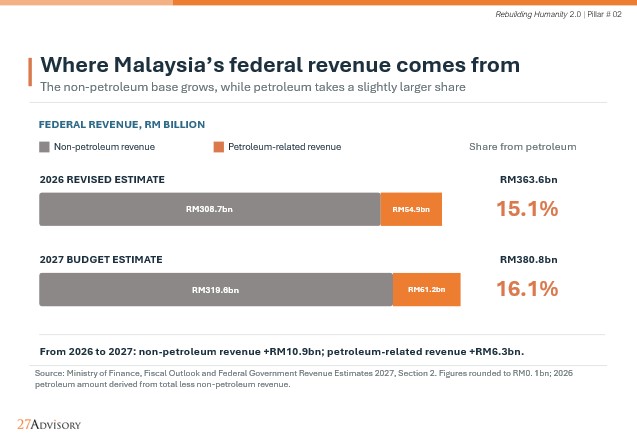
The 2027 projections show the task ahead. Non-petroleum revenue is projected to grow 3.5% to RM319.6 billion. Yet petroleum-related receipts are expected to rise from 15.1% to 16.1% of total revenue, partly because the PETRONAS dividend is projected at RM32 billion. A dividend is a transfer from PETRONAS, which has its own investment needs. The test is whether wages, profits and spending grow strongly enough to carry more of the burden when the oil cushion recedes.
Protection should follow need
How support is designed matters as much as how it is funded. A fuel subsidy gives more to people who buy more fuel. Apurva Sanghi, the World Bank’s lead economist for Malaysia, has said that fuel subsidies in Malaysia are regressive, “with the T10, T20 benefitting much more compared to others.” A household with several eligible drivers can receive more than a family with one old motorcycle. People without vehicles receive nothing directly at the pump.
Yet fuel costs reach everyone. Diesel moves food, goods and deliveries. When diesel costs rise, families feel it at the market, not only at the station. This is why support beyond the pump matters. Budget 2027 raises the combined STR and SARA allocation to RM16 billion and extends monthly SARA assistance of up to RM150 to all STR recipients. That support can reach eligible households whether or not they own a vehicle.
Fairness also means recognising legitimate needs. A rural worker with no practical bus service may use more fuel than a city resident near a rail line. Farmers, carers and workers who move between job sites face real constraints. The higher allowance already given to e-hailing drivers shows the system can recognise working needs. Any tighter rule in future should have a usable appeal process built in from the start.
Better data can make that support fairer. Dr Lee Hwok Aun of the ISEAS-Yusof Ishak Institute points out that “LHDN data on Malaysia’s six million income taxpayers could be integrated with PADU”, giving a clearer picture of which households need help. Where cash support is needed, he suggests that “targeted cash transfers could be provided on a geographic or sectoral basis”, for example for rural residents and commercial transporters. Sanghi adds that income thresholds should be adjusted for household size and location. An income that is comfortable in a small town can be tight in Kuala Lumpur.
The deepest constraint is choice. Only about 20% of Malaysians use public transport, which Dr Lee calls “an under-recognised constraint” on reform. Without a real alternative to the car or motorcycle, every rise in fuel prices lands directly on the household budget. Reliable buses, rail and efficient freight reduce how much fuel daily life requires, and how much protection the budget must provide. They take years to build, which is exactly why they need to start now.
Lessons Malaysia can use
Malaysian and international experts point in the same direction: move gradually, by rule, and protect those who need it most. Two lessons can be applied directly.
A rule for the price. Chile shows how such a rule works. Since 2014, its MEPCO mechanism has adjusted a variable part of the fuel tax to keep pump prices within a reference band, so that prices move gradually rather than in sudden jumps. During the 2026 shock, Chile used an exceptional rule to pass more of the increase through to consumers.
Malaysian voices have reached a similar conclusion. Dr Lee argues that “the alternative of an across-the-board phased subsidy reduction should be raised”, allowing smaller and more manageable price changes. Sanghi advises Malaysia to “float fuel prices”, but to do it “slowly”.
For Malaysia, this means deciding in calm times how much support per litre the budget will carry. Beyond that level, the pump price would move in small, announced steps, with cash support for lower-income households. Publishing subsidised litres, support per litre and savings against a clear baseline every month would make the rule visible and trusted. Such rules are easiest to set before a shock, not during one.
A buffer for the money. Norway separates receiving oil money from spending it. Petroleum income flows into a fund, and the budget draws on it according to the fund’s expected real return, around 3% a year.
Malaysia has its own starting point. The KWAN Bill 2026 requires contributions linked in part to PETRONAS dividends and limits withdrawals to education, healthcare and climate measures. A fuel shock has no window in these rules. In 2026, the expected PETRONAS dividend was revised up by RM7 billion. A rule that set aside part of any such surprise for energy shocks would turn a lucky year into a planned buffer. Regular stress tests should then show how long that buffer would last if refined fuel stays expensive for another year, or becomes more expensive.
Thailand shows why that buffer must be built before it is needed. Its Oil Fuel Fund held prices down by taking on liabilities, and on 11 October 2026 it reported a net negative position of about THB101.7 billion across its oil and LPG accounts. A fund that borrows to hold prices down does not remove the cost. It only moves it.
Protection that lasts
Budget 2027 shows that reform has given Malaysia room to protect its people through a severe energy shock. The next reforms should make sure that room does not depend on the price of oil. For the family filling up at RM1.99 today, the question is not only whether this month’s price holds. It is whether Malaysia has built enough strength, and clear enough rules, to keep protecting that family the next time the world sends a shock.
This article is part of 27Advisory’s Rebuilding Humanity 2.0 framework, a nine-pillar knowledge architecture for navigating Malaysia’s most consequential structural transitions. The themes explored in this piece connect directly to Pillar #02: Radical Fiscal & Governance Reset, which examines how Malaysia redesigns revenue sharing, fiscal transfers, and institutional accountability so that public resources are tied to measurable outcomes and governance is strengthened at every level. To explore 27Advisory’s sectoral research and advisory work, visit our Rebuilding Humanity 2.0 page.