

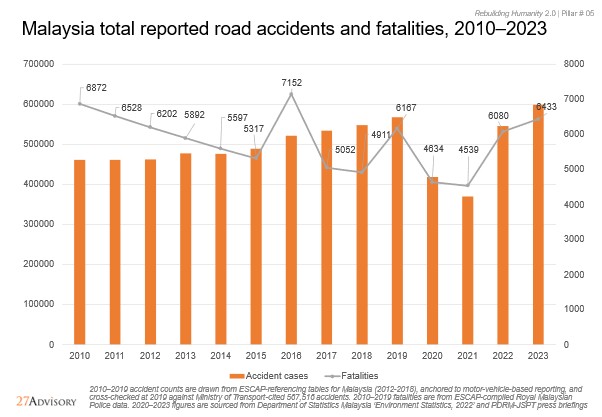
Every day, eighteen people die on Malaysian roads.
Not in conflict. Not from disease. On the way to work, to school, to somewhere ordinary.
Eighteen families receive a call they were not expecting. Eighteen futures stop. And the country absorbs the loss quietly, the way it always has, and moves on.
This should not be normal. But it has become normal.
We know the numbers. We just do not count them properly.
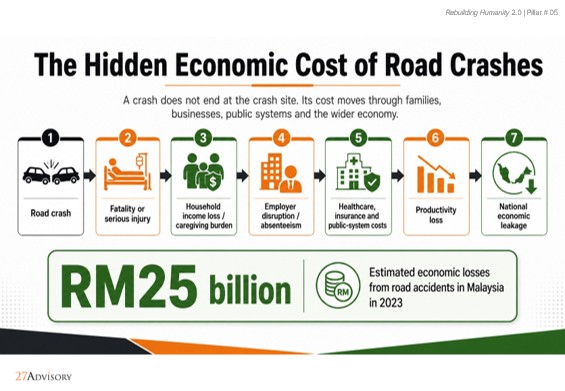
In early January 2024, PDRM reported that Malaysia recorded over 598,635 road accidents in 2023. The economic losses that year exceeded RM25 billion, roughly 1.4 percent of GDP. Transport Minister Anthony Loke cited the figure in July 2024 when explaining the need to accelerate the implementation of PKJRM 2022–2030, Malaysia’s national road safety plan. Such losses typically include emergency response, hospital care, vehicle damage, insurance claims and wider productivity losses.
But it does not include the worker who will not return to the factory floor. The father whose income stopped on a Tuesday morning. The young graduate three months into her first job. The delivery rider who was somebody’s only son.
These losses are real. They are measurable. We simply have not been measuring them.
There are tools for this. We are not using them well enough.
Two tools exist specifically to count what we have been leaving out.
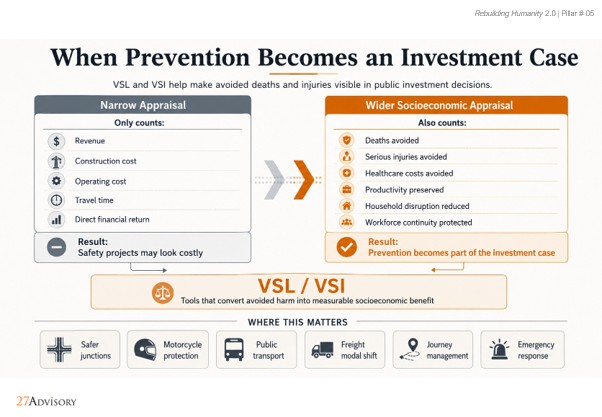
Value of Statistical Life, or VSL, estimates the economic value of preventing one death. Value of Statistical Injury, or VSI, estimates the economic value of preventing one serious injury.
They do not put a price on a person. That is not their purpose. Their purpose is to make prevention visible in economic decisions.
Here is why this matters. When a government agency evaluates a road project, it counts construction cost, travel time saved and direct financial return. What it rarely counts is how many deaths and serious injuries that project would prevent. Without VSL and VSI, those prevented deaths are invisible in the calculation. The project looks expensive. Prevention loses to cost.
With VSL and VSI, the calculation changes. A safer junction, a protected motorcycle lane, better road lighting — these stop looking like costs and start looking like returns.
Prevention becomes an investment case. But only if we are honest about what prevention requires.
And prevention in Malaysia requires more than telling people to drive carefully.
The approach must be wider than we think.
Behaviour and infrastructure are not enough on their own.
Even a well-built road can become dangerous. When roads improve, speeds increase. When speeds increase, exposure time grows. And when exposure time grows on open stretches, the risk of a fatal outcome does not disappear. It changes shape.
This is why road safety cannot be treated as a single-ministry problem. It needs a whole-of-system approach. Infrastructure, speed management, land use planning, public transport access and employer responsibility must move together. When they do not, fixing one part of the system simply shifts where the danger lives.
And none of this can be done well without honest, transparent data.
Malaysia needs stronger public access to cause-level and injury-level crash data. Not aggregated. Not delayed. Detailed enough that planners, investors and policymakers can see exactly where the danger is concentrated and what kind of intervention will deliver the highest return. Right now that data is not easy to access. Without it, prevention spending is a guess dressed as a plan.
When we look at what the data does show, it leads us somewhere uncomfortable.
Motorcycle crash data show where prevention must begin.
When we look at what the data does show, it leads us somewhere uncomfortable.
Historical MIROS data shows that motorcycle risk in Malaysia is not concentrated on dangerous highways or in exceptional circumstances. It is embedded in ordinary mobility. Many crashes occurred on straight roads and in everyday environments such as residential and industrial areas. The victims were strikingly young: half of killed riders were aged 29 and below, while half of killed pillions were aged 21 and below. These were not distant tragedies on unfamiliar roads. They were losses woven into the daily routes of work, school and home.
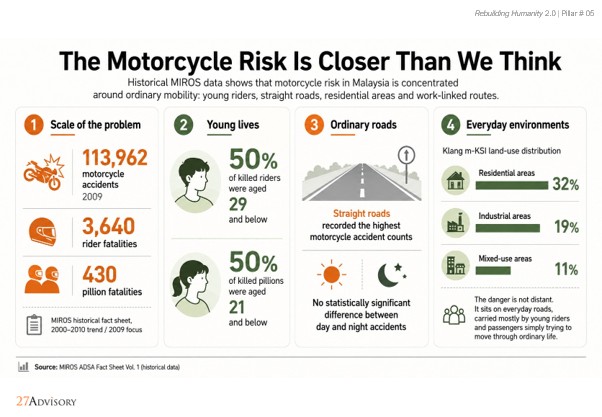
That pattern has not changed. Around 60 percent of road deaths in Malaysia continue to involve motorcyclists, and recent data suggests the share may now be even higher. Global research is consistent on who these road users tend to be. Road crash risks and consequences fall more heavily on lower-income groups, especially where safer transport alternatives are limited.
In Malaysia, the motorcycle is not a lifestyle choice for most of its riders. It is often the only practical and affordable way to reach income. It is the vehicle of the worker, the contractor, the delivery rider, the young person three years into a first job who has not yet saved enough for a car.
When we lose them, we do not only lose a person. We lose years of productive life, future earnings and the stability that person could have brought to a household. In economic terms, MIROS’ 2018 Value of Statistical Life estimate places the cost to the Malaysian government at a minimum of RM3.12 million for every life lost on the road. Yet even that figure cannot fully capture what is taken from a family, a workplace and a country each time a young life is cut short.
A transport system that depends on motorcycles but does not invest seriously in protecting motorcyclists is not only unsafe. It is quietly dismantling the very workforce it relies on.
These are not people who can afford to absorb the risk we have handed them. They ride because they have no choice. The least we can do is build roads, junctions and systems that give them a fighting chance of arriving.
The Road Has Entered the Workplace
Many businesses have not yet noticed.
PKJRM records that road crashes involving workers during journeys increased by 83 percent in 2019 compared with 2009. In that same year, 705 workers died in commuting accidents, compared with 254 deaths from workplace accidents.
More recent SOCSO data shows the pattern continuing. In 2023, commuting accidents accounted for 38,454 cases, or 46.4 percent of all work-related accidents. Commuting fatalities accounted for 750 deaths, or 70.8 percent of all work-related fatalities.
More workers are dying on the road than at work. The road is not separate from the workplace. It is part of it.
For businesses that depend on fleets, delivery riders, field teams, contractors or commuting workers, road risk is operational risk. It is also a hidden cost that most businesses have not yet named or measured.
There are already models to build from. Malaysia’s Work-Related Road Safety Support Programme has shown that structured support can improve journey management, fleet selection and driver management. In the platform economy, foodpanda Malaysia’s pandasafe programme shows how rider safety can be addressed through training, certification and technology. In high-risk sectors, Shell’s contractor guidance treats road travel as a formal safety process under HSSE requirements.
Road safety should not sit under CSR. It belongs within operational risk, workforce protection and business continuity. But corporate Malaysia cannot move far without government moving with it.
Malaysia is not starting from zero
PKJRM 2022 to PKJRM 2030 exists. It aligns with Vision Zero principles. It identifies safer motorcycling, speed management, safer infrastructure, safer vehicles and post-crash response as priorities.
The direction is already widening. The Transport Ministry has also been studying Transit Oriented Development, which can reduce dependence on private vehicles by building communities around public transport. If fewer people need motorcycles for daily mobility, fewer people are exposed to road risk. Road safety then becomes not only a transport issue, but also a planning, housing and development issue.
That is the right conversation to be having.
The harder task now is converting direction into funded, measurable action, with named institutions and real accountability. VSL and VSI are part of that conversion. They give planners and decision makers a common language for counting what prevention is worth.
The Cost We Can No Longer Ignore
The question is no longer whether Malaysia can afford to invest in safer roads. It is whether Malaysia can afford to lose eighteen more people tomorrow.
They are not statistics. They are workers, breadwinners and somebody’s reason to come home.
Malaysia cannot recover the lives already lost. But it can decide that prevention will no longer remain an afterthought. The cost we never counted must now be counted, funded and measured.
Eighteen people should make it home. Every single day.
This article is part of 27Advisory’s Rebuilding Humanity 2.0 framework, a nine-pillar knowledge architecture for navigating Malaysia’s most consequential structural transitions.
The themes explored in this piece connect directly to Pillar #05: Infrastructure, Water and Climate Resilience, with a focus on how safer, more efficient transport systems can reduce the economic and social burden of road crashes.
To explore 27Advisory’s sectoral research and advisory work, visit our Rebuilding Humanity 2.0 page
Sources:
- Loke, A. F. (2024, July 16). Road accident losses last year cost Malaysia RM25b, up from previous years: Loke. New Straits Times. https://www.nst.com.my/news/nation/2024/07/1074998/road-accident-losses-last-year-cost-malaysia-rm25b-previous-years-loke
- Ministry of Transport Malaysia. (n.d.). Malaysia Road Fatalities Index. https://www.mot.gov.my/en/land/safety/malaysia-road-fatalities-index
- New Straits Times. (2024, January 30). 598,635 road accidents recorded in 2023. New Straits Times. https://www.nst.com.my/news/crime-courts/2024/01/996067/598635-road-accidents-recorded-2023
- Ranjit Singh, S. S., & Nordin, A. (2024). Addressing the safety and health risks of gig workers in Malaysia. Journal of Occupational Health, 66(1), e12540. https://pmc.ncbi.nlm.nih.gov/articles/PMC11417540/
- foodpanda Malaysia. (n.d.). PandaSafe. https://pandariders.my/pandasafe/
- Shell. (n.d.). Journey Management. https://www.shellcontractor.com/journey-management/
- Ministry of Transport Malaysia. (2022). Malaysia Road Safety Plan 2022–2030. Ministry of Transport Malaysia. https://www.mot.gov.my/en/Pages/Land/Safety%20and%20Security/MRSP%202022-2030%20(1022).pdf
- The Star. (2025, February 5). Perkeso’s efforts to reduce workplace accidents show results. The Star. https://www.thestar.com.my/news/nation/2025/02/05/perkesos-efforts-to-reduce-workplace-accidents-show-results
- Bakar, H., Rusli, R., Adinegoro, Y., & Baharudin, M. R. (2025). Enhancing workplace road safety through the Work-Related Road Safety Support Program. Environment-Behaviour Proceedings Journal, 10(34), 237–242. https://doi.org/10.21834/e-bpj.v10i34.7364
- Malaysian Institute of Road Safety Research. (2011). ADSA Fact Sheet Vol. 1: Motorcycle. MIROS.
- Malaysian Institute of Road Safety Research. (2011). ADSA Fact Sheet Vol. 2: Motorcycle. MIROS.