
Malaysia has treated net zero as a 2050 problem for long enough that it has quietly become a 2026 problem. The horizon did not move. We simply ran out of distance.
That habit is now expensive.
Not metaphorically expensive. Not reputationally expensive in the way sustainability reports tend to mean when they use that word carefully. Expensive in the way that shows up in export revenues, in foreign reserve calculations, in the ringgit’s response to a carbon border it was not adequately prepared for.
The clock is not counting down to 2050. It has already been running. And Malaysia is behind.
The Bill That Has Already Arrived
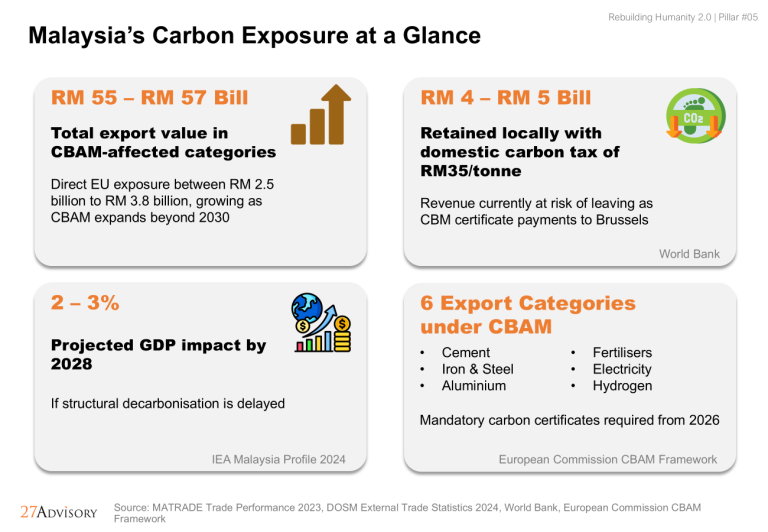
In Brussels, a quiet but consequential piece of trade architecture came into force. The European Union’s Carbon Border Adjustment Mechanism (CBAM) does not announce itself with drama. It arrives as a compliance form, then a reporting requirement, then a certificate purchase obligation. By 2026, Malaysian exporters of cement, iron, steel, aluminium, fertilisers, electricity and hydrogen must buy carbon certificates for every tonne of emissions embedded in their products. Products that cannot demonstrate low-carbon credentials will cost more to sell into Europe. Buyers will notice. Some will redirect their sourcing.
The estimated annual exposure for Malaysia spans RM55 to 57 billion in total export value across CBAM-affected categories globally, with direct EU-bound exposure currently estimated at RM2.5 to 3.8 billion — a figure that will grow as the EU expands CBAM’s reach and tightens carbon certificate requirements beyond 2030.
The exposure is not evenly distributed. Iron and steel carries the heaviest load, with an estimated RM28.5 to 30.2 billion in annual export value and direct EU market linkages through Germany and Italy, with Ann Joo Steel, Lion Industries and Alliance Steel among the most exposed players. Aluminium follows at RM20.4 billion, where Press Metal Aluminium Holdings faces the most significant single-company risk. Fertilisers add RM4.8 to 5.2 billion, with Petronas Chemicals Group and FGV Holdings in the frame. Cement, hydrogen and electricity round out the six categories, though their current direct EU exposure remains limited — for now.
And CBAM is not alone.
The EU Deforestation Regulation, following a one-year delay confirmed in December 2025, now requires full compliance from Malaysian large operators by December 30, 2026, and from SMEs by June 30, 2027. The reprieve is narrow. Malaysia remains classified as high-risk pending an EU benchmarking review due April 2026 — and no formal exemptions have been confirmed. Every shipment of palm oil, rubber and wood-based goods entering Europe must be proven deforestation-free, fully traceable and compliant with Malaysian law. EU importers face penalties of up to 4% of their annual turnover for non-compliance, which means they will impose that discipline onto their Malaysian suppliers through stricter contracts, tighter audit rights and documentation demands that many smaller producers are not yet equipped to meet.
The lesson has already been delivered once, at cost. When FGV Holdings withdrew RSPO certification for its upstream operations in February 2020, the impact was immediate. Kenanga Research placed the premium loss at approximately US$25 per tonne of certified palm oil — a direct commercial penalty for sustainability non-compliance that buyers translated immediately into sourcing decisions. This was not a fine imposed by a regulator. It was a market signal, sent without ceremony.
Sustainability non-compliance is no longer a reputational risk. It is a commercial liability with a number attached.
The World Bank estimates that a domestic carbon tax of RM35 per tonne could retain RM4 to 5 billion annually within Malaysia’s own fiscal architecture — revenue that would otherwise leave as CBAM certificate payments to Brussels. The choice is not between taxing carbon and not taxing carbon. It is between taxing it here or paying for it there.
The Flood in Your Street Is Not a Weather Event
There is a second bill, less legible but equally real. It arrives not in a compliance document but in the frequency of what Malaysians have begun to accept as normal.
Floods that once struck every few years now arrive multiple times annually. The Klang Valley, Johor, Kelantan; each event costs billions in infrastructure damage, business disruption and household losses. Heatwaves strain the national grid and suppress outdoor labour productivity. Coastal communities face steady inundation that no amount of goodwill can reverse without structural intervention.
Malaysia’s climate exposure used to feel abstract. It no longer has that luxury.
What is still underappreciated is the economic transmission mechanism. Climate risk is not a separate category from economic risk. It is economic risk, wearing different clothes. Every flood that disrupts a supply chain raises insurance premiums. Every heatwave that reduces agricultural yield tightens food prices. Every climate event that damages infrastructure requires fiscal resources that could have been deployed elsewhere — resources that, in a tightening global environment, are harder to replace.
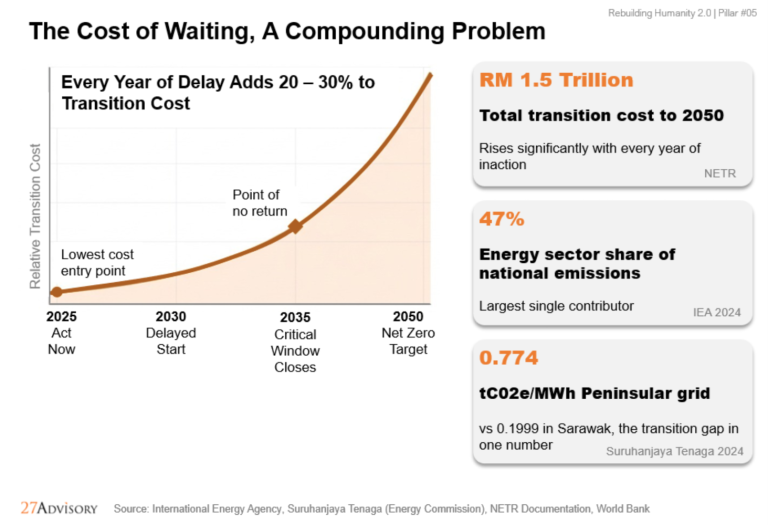
Malaysia’s carbon intensity sits at 0.32 kg of CO2 per dollar of GDP — higher than Thailand at 0.25, though below Vietnam’s coal-heavy 0.41. The national grid runs at 0.774 tonnes of CO2 per megawatt hour on the Peninsula, compared to just 0.199 in Sarawak — a gap that tells the story of the transition opportunity more clearly than any policy document. Energy generation accounts for 47% of national emissions. Transport adds another 25%. These two sectors alone represent nearly three quarters of Malaysia’s decarbonisation challenge.
The International Energy Agency has been consistent on one point that Malaysia’s policy discussions tend to quietly sidestep: each year of delay raises the total cost of transition while simultaneously narrowing the available policy choices. This is not a warning about 2050. It is a compounding interest calculation, and it is running now.
The Opportunity Side of the Same Coin
It would be a failure of honest analysis to present only the exposure without naming the opportunity that sits on the other side of it. Malaysia is not merely a nation being pushed toward net zero by external pressure. It is a nation with genuine structural advantages in a world that is reorganising itself around clean energy.
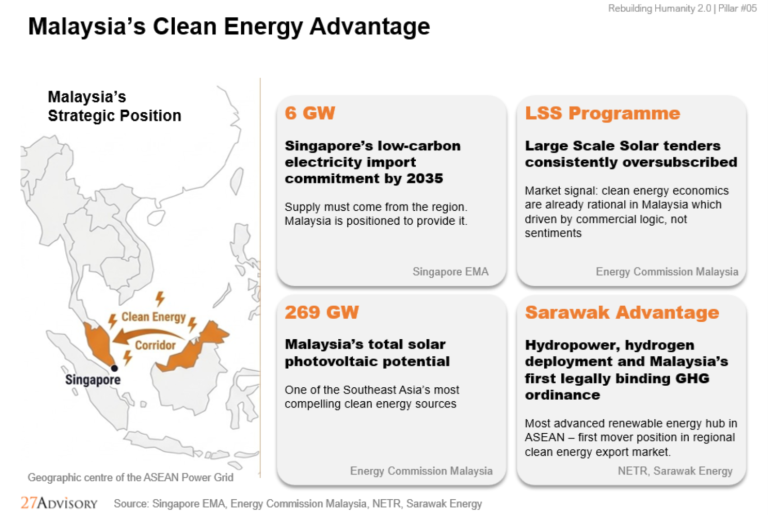
Consider the ASEAN Power Grid, long discussed as a regional aspiration and now quietly becoming infrastructure reality. Singapore has committed to importing 6 gigawatts of low-carbon electricity by 2035. That power must come from somewhere in the region. Malaysia, sitting at the geographic centre of the ASEAN grid, with Sarawak’s hydropower inheritance, its abundant solar irradiance and its proximity to Singapore’s demand, is positioned to become a net exporter of clean energy to a market that is actively looking for reliable supply.
That is not an environmental story. That is a revenue stream. One that rewards early movers and closes permanently to those who hesitate.
The Large-Scale Solar programme has already demonstrated that this is not theoretical. The LSS tenders have been consistently oversubscribed, not because Malaysian developers are idealistic, but because the economics are now rational. Solar in Malaysia is competitive. The market has already voted.
The question is whether the policy architecture can keep pace with the commercial momentum.
What 2026 Is Actually Testing
The question 2026 is asking Malaysia is not a new one. It simply arrived with more urgency than anyone anticipated.
On February 28, the effective closure of the Strait of Hormuz sent Brent crude briefly past $119 per barrel and triggered a 60% surge in Asian LNG benchmarks. For Malaysia, as a net energy exporter, the instinct was to assume insulation. That instinct was wrong. We found ourselves watching a price spike we could not fully capture, while simultaneously absorbing the import inflation and currency pressure of a nation still deeply wired to fossil fuel supply chains. The Hormuz disruption did not create Malaysia’s energy vulnerability. It simply made it impossible to look away from.
The policy response came quickly. On March 12, the Malaysian government announced it was studying work-from-home arrangements for civil servants, not as a pandemic legacy, but explicitly as an energy conservation measure following Thailand’s lead. A special Cabinet meeting on March 13 was convened to examine Brent crude trajectories, aviation fuel costs, and MSME protection measures. These were not environmental policy discussions. They were energy security decisions made under geopolitical pressure, converging without announcement on the same destination the net zero transition has always pointed toward: a Malaysia less structurally exposed to the price of a barrel of oil it does not control.
That destination already has a blueprint.
Malaysia enters this pressure test with something most transitioning economies genuinely lack: the National Energy Transition Roadmap (NETR). Not a wish list. One of the most structured transition architectures in ASEAN, with measurable milestones, defined investment pathways, and a power sector transformation plan built around Tenaga Nasional Berhad’s grid upgrade programme. The achievement is real and should be acknowledged as such.
But a blueprint is not a building. And 2026 is the year the distance between the two becomes impossible to ignore.
The European trade rules are not waiting for Malaysia’s institutional readiness. The carbon border does not pause while ministries coordinate. The insurance markets repricing climate risk do not offer extensions to economies still debating governance structures. The window in which early action is rewarded over late action is measurable, and it is narrowing.
Malaysia’s transition is not optional. That question was settled years ago by the physics of climate change and the politics of global trade simultaneously. The question that 2026 is actually asking is simpler and more urgent:
Will Malaysia lead this transition or be led through it?
The answer will not be written in a policy document. It will be written in the decisions made this year, this quarter, this budget cycle. In whether the financing is mobilised at the scale required, whether the governance is coordinated at the speed demanded, and whether the commercial opportunity in clean energy is seized before the window closes.
The clock has been running.
It is time to run with it.
This article is part of 27Advisory’s Rebuilding Humanity 2.0 framework, a nine-pillar knowledge architecture for navigating Malaysia’s most consequential structural transitions. The themes explored in this piece connect directly to Pillar #05: Infrastructure, Water & Climate Resilience. This pillar examines how Malaysia builds the physical and institutional foundations required to absorb climate shocks while capturing the clean energy opportunity. To explore 27Advisory’s sectoral research and advisory work, visit our website CLICK HERE